Here’s what Bryan Johnson’s Blueprint actually involves and how following it can benefit you.
Before Blueprint, Bryan Johnson was chronically depressed for ten years. He’s described Sundays as his worst days. He desperately wanted to die. The question that started everything wasn’t “how do I live forever.” It was simpler than that: what do you do with life?
Blueprint is his answer. He started it formally in October 2021, at age 44, as a structured attempt to slow his own biological aging by measuring everything and following the data wherever it led.
TLDR: Bryan Johnson’s Blueprint Plan
- The origin: A decade of depression and post-exit burnout, not vanity, led Johnson to build Blueprint in October 2021 at age 44.
- Sleep first: He calls it the number one longevity drug in the world, with a five-habit routine and a resting heart rate of 41 to 43 bpm as his north star.
- Exercise: Six hours a week, split into strength and cardio, plus movement every 20 to 30 minutes.
- Diet: Three timed meals all finished by noon, plant-based by his own choice rather than a Blueprint rule.
- The stack: A defined supplement routine taken in the morning, prepped in 30-day batches.
- Skin and hair: A short daily routine now built entirely on Blueprint’s own SFC-based products plus nightly tretinoin, alongside a topical and laser hair stack.
- Oral and eye care: A twice-daily oral routine and eye-specific carotenoids, both tracked like every other marker.
- Prescriptions: Several medications he takes for his own diagnosed conditions under physician supervision, not part of a general protocol.
- Advanced therapies: Sauna, HBOT, and light therapy that he pursues with his own data and medical team.
- Results he reports: Skin he measures as roughly 9 years younger than his age, plus various 98th and 99th percentile biomarkers, all self-measured.
- What he dropped: Plasma transfusions, growth hormone, and rapamycin, each abandoned when the data didn’t hold up.
- For women: Blueprint’s separate protocol, presented by CMO Kate Tolo, adjusts training and supplements by cycle phase.
What Is Blueprint, And The “Don’t Die” Idea Behind It

Blueprint is a system. The order matters: sleep, then exercise, then diet, then supplements, then the more experimental therapies on top. Bryan Johnson uses that hierarchy himself, and most of the value sits in the first three layers.
The framing he gives is “Don’t Die.” His argument is that we may be the first generation that doesn’t have to die, and that the goal is less about individual immortality and more about, in his words, being warriors and caretakers of existence. Bryan Johnson describes himself as a collection of 70 trillion cells, and aging as simply the point where breakdown outpaces repair. Blueprint is the attempt to flip that ratio.
Hear Johnson explain being warriors and caretakers of existence here. This clip starts at ≈11:57.
One distinction runs through everything below. What Bryan Johnson does personally isn’t the same as what Blueprint suggests for anyone else. He’s vegan by choice, and as he puts it, Blueprint says nothing about meat (source). The idea is to look at the evidence and measure your personal results, not to follow his lifestyle.
Sleep: The Foundation

Johnson’s blunt about the hierarchy. Sleep comes first. He calls it the number one longevity drug in the entire world, with nothing more powerful than it. His reasoning is sequential: if you don’t sleep, you won’t exercise, and if you don’t exercise, you won’t eat well. Everything else depends on it.
His own targets are specific:
- Wake at 5 AM, bed at 8:30 PM: A fixed schedule, with bedtime varying by no more than 30 minutes either side.
- Eight hours in bed: Built around an ideal of roughly two hours deep, two hours REM, under 30 minutes awake, and falling asleep within about five minutes.
- Resting heart rate of 41 to 43 bpm: His single most-watched marker before bed.
Bryan Johnson has said the best thing most people can do is focus on their resting heart rate before bed, calling it the one marker in their life to pay attention to. His reasoning is that health advice gets overwhelming fast, and one number cuts through the noise about seed oils and which drink to have.
The logic he describes is short. He treats a low resting heart rate as the sign that the body is settled enough to sleep well, and good sleep as what gives him the willpower and the mood to keep the rest of the protocol going. That turns a vague goal into one practical question, which is how to bring the number down.
Listen to Johnson call sleep the number one longevity drug in the world here. This clip starts at ≈26:51.
Research does link the two, though mostly in the other direction, with better sleep associated with a lower resting heart rate rather than the reverse.
His five sleep habits are his answer to that question, and they are simple and mostly free.
- Eat earlier: Finish the final meal at least four hours before bed. Bryan stops eating at noon. As far as we can tell, the noon cut-off is a personal choice rather than having a strong evidence base.
- Screens off 60 minutes before bed: Followed by a wind-down routine of about an hour.
- Manage lighting: Dim or red light at home in the evening, bright light in the morning.
- Keep a consistent bedtime: Same time nightly, within roughly 30 minutes.
- Deal with anxiety before bed: Settle the mind rather than carrying the day into the pillow.
Bryan Johnson frames the body as a clock that loves routine, and he leans on systems rather than willpower to protect the schedule.
For a fuller take on the science of sleep habits, Matthew Walker’s 12 tips for good sleep cover similar ground from a researcher’s angle.
Exercise: Six Hours A Week
Bryan Johnson trains about six hours a week, split into three strength sessions and three cardio sessions, and says he never misses it (source).
The cardio half breaks down by intensity:
- 150 minutes of Zone 2: Lower-intensity aerobic work, the kind you can hold a conversation through.
- 75 minutes of HIIT: Higher-intensity intervals.
That comes to 3 hours 45 minutes of cardio a week, with the remaining time going to strength.
On top of the structured sessions, he adds daily movement, getting up and moving every 20 to 30 minutes throughout the day rather than sitting for long stretches. He rarely sits still for long.
He reports fitness results placing him in the upper percentiles for 18-year-olds. As with all of his metrics, these come from his own testing, and the percentile framing is his.
Diet: Three Meals, All Before Noon

Bryan Johnson eats three timed meals, all finished by noon. Then nothing more that day. The full day runs to about 2,250 calories with roughly 130g of protein. He drinks no caffeine after noon and, for his own reasons, no alcohol at all.
The three meals, in order:
- The morning Blueprint stack: Longevity Mix, a protein component, Nutty Pudding, and his morning pills.
- Super Veggie (around 11 AM): A large vegetable bowl, detailed below.
- A third meal by noon: Typically something like a stuffed sweet potato with chickpeas, avocado and tomatoes.
Hear Johnson describe his entire morning meal, taken in one sitting here. This clip starts at ≈2:45.
His Super Veggie recipe (source) is fixed and substantial:
- Black lentils, 45g dry
- Broccoli, 250g
- Cauliflower, 150g
- Shiitake or maitake mushrooms, 50g
- Garlic, ginger, lime, cumin, hemp seeds, apple cider vinegar
- A drizzle of Blueprint extra virgin olive oil
He takes about one and a half tablespoons of extra virgin olive oil across the day (source). Olive oil is one of the few things he’s openly enthusiastic about.
For most people he points to a Mediterranean-style diet as the sensible baseline rather than his own vegan version.
The alcohol decision follows the same logic. Blueprint doesn’t forbid it. Bryan stopped because three ounces of wine cost him around 72 calories he’d rather spend elsewhere, and because alcohol near bedtime wrecks his sleep. In his framing, moderate alcohol is reasonable. It just doesn’t fit his own goals.
See Bryan Johnson explain exactly why he stopped drinking here.
One of his more memorable lines is about systems over willpower. He’s described firing “evening Bryan,” the version of himself between 5 PM and 10 PM who would overeat, by making a flat rule that he doesn’t consume food in that window. The rule does the work so willpower doesn’t have to.
The Blueprint Stack: Supplements
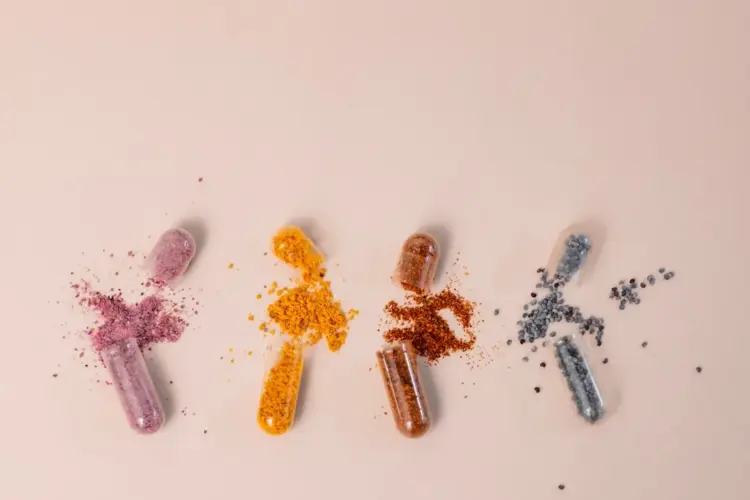
Bryan Johnson takes his supplements in the morning. Many of the ingredients are energizing and would interfere with sleep later in the day. For a deeper breakdown of every product, see our dedicated Bryan Johnson supplement list.
What he personally takes includes:
- Blueprint Essentials: 2 capsules
- Advanced Antioxidants: 1 capsule
- Ashwagandha and Rhodiola: 1 capsule
- EPA/DHA: 800mg
- Creatine: 7.5g total (5g plus 2.5g already in the Longevity Mix)
- Collagen peptides: 20 to 30g per day
- Longevity Protein and Metabolic Protein
- Extra virgin olive oil: 3 tablespoons
His morning pill routine, in his own description, is eight pills: three essential capsules, three of NAC, ginger and curcumin, one red yeast rice and odor-free garlic, and one softgel.
Hear Johnson describe his eight-pill morning routine here.
How He Preps It
Bryan Johnson is clear that taking the whole stack in one sitting works for him only because his body has acclimated to it. For anyone starting out he favours introducing one item per day, perhaps the Longevity Mix first, then Nutty Pudding, then a single pill at a time, so the body can adjust gradually (source).
Other Popular Longevity Supplements
Beyond Johnson’s specific picks, several supplements come up repeatedly in longevity circles and pair naturally with this kind of routine. These are general options rather than his choices:
- Magnesium glycinate: A commonly used form for sleep and muscle relaxation.
- Vitamin D3 with K2: Frequently paired, with K2 supporting calcium transport.
- A quality omega-3 fish oil: For readers who don’t want a vegan EPA/DHA source.
- Curcumin with black pepper extract: Often taken for its anti-inflammatory profile.
Skin And Hair
Skin and hair each get their own protocol within Blueprint, and like everything else they’re tracked rather than guessed at. Johnson has his skin measured with VISIA Complexion Analysis. He is 48, and his skin scores as that of a 39 year old, so about nine years younger than his real age (source).
The change over time is smaller than that nine-year gap suggests. When he started Blueprint at 44, his skin already scored as a 40 year old. Four years later it scores 39. In other words, his skin measures a year younger now than it did then, while his body has aged four years. It’s the result he points to when defending the effort that goes in.
Skincare
One thing has changed since his earlier routine, and it’s worth stating plainly: he now uses Blueprint’s own skincare products almost exclusively. The CeraVe cleanser, EltaMD sunscreen and standalone niacinamide and vitamin C that featured a couple of years ago have been folded into Blueprint’s own line. He both uses these products and sells them, so it’s worth holding that commercial context in mind even as the measured results look real.
The daily routine itself is short. Morning and night he cleanses, applies a serum, then a moisturiser, and at night he adds tretinoin:
- Blueprint Cleanser: Opens the morning and evening routine, clearing the day’s oil, dirt and residue.
- Blueprint Serum: The most active step, carrying the highest concentration of the line’s hero ingredient.
- Blueprint Moisturizer: Seals in the serum and reinforces the barrier. The three together run $167 as a bundle.
- Tretinoin (prescription, at night): A retinoid with the strongest independent evidence of anything in his routine. Older accounts cited a 0.025 to 0.1% strength; he no longer specifies one.
The common thread across the three Blueprint products is SFC (Disodium Succinoyl Farnesylcysteine), which the brand positions as its headline active and claims outperforms niacinamide for the look of fine lines. That comparison comes from brand-funded studies rather than independent trials, so read it as a claim rather than settled fact. The serum also carries NMN and hyaluronic acid.
Underneath the products sit the same free basics that run through the rest of Blueprint: he avoids direct sun between 10am and 4pm, covers up or uses a mineral sunscreen when he can’t, sleeps seven to nine hours, and eats whole foods. He also feeds skin from the inside, with collagen peptides (20 to 30g daily), olive oil polyphenols, cocoa flavanols, berries, and hyaluronic acid in his Longevity Mix.
On top of all that he runs a set of twice-yearly in-clinic treatments aimed at the face: a 1927nm laser for surface tone and texture, a 1550nm laser for deeper collagen, Sofwave focused ultrasound, and Everesse radiofrequency. For the full product-by-product breakdown, the in-clinic lasers and the whole-body therapies he credits for his skin, see our dedicated Bryan Johnson skincare routine.
Hair
The hair protocol is separate from the oral minoxidil noted under prescriptions above, and combines a topical drug, two Blueprint products and a device (source):
- Topical minoxidil: A 7% solution, around 1ml applied to the scalp each night, followed by a one to two minute scalp massage with a silicone scrubber to stimulate blood flow.
- Blueprint Peptide Shampoo: One to two pumps worked into the scalp and massaged for about two minutes before rinsing, using a nanoliposome system to deliver peptides to the follicles.
- Blueprint Peptide Serum: One full dropper applied to a dry scalp daily, covering the whole scalp.
- Blueprint 302 Laser Cap: A red-light cap at 655nm, worn six minutes a day, often during the morning routine, to activate the serum’s ingredients.
Johnson is upfront that none of this is fast: meaningful changes to scalp and hair health take at least four months, and consistency over that window is the point. The topical work is backed up from the inside by protein, omega-3s, biotin and the wider supplement stack.
Oral Care
Bryan Johnson treats teeth and gums as another measurable system. (source). The order is deliberate: each step clears what the last one couldn’t reach.
- Water flosser first: A high-pressure water stream loosens food, plaque and bacteria from the gaps a brush misses.
- Then floss: To lift the debris the water flosser has loosened.
- Brush: Soft bristles, electric or manual.
- Tongue scraper: Used twice a day. He calls it a game changer for oral hygiene, since the tongue harbours much of the bacteria behind bad breath.
- Professional cleanings: At least twice a year.
- A night guard: A custom SomnoDent device worn while sleeping, on the recommendation of a dentist, to manage two decades of teeth grinding.
The diet side tracks the rest of the protocol. He suggests cutting sugar where possible, favouring alternatives like trehalose, monk fruit, xylitol or allulose; limiting extended exposure to acidic drinks such as coffee, which softens enamel; and staying hydrated so saliva can keep doing its protective, remineralising job.
Eye Health
Eye care is the smallest of these pieces, but it’s a deliberate part of the protocol rather than an afterthought. Two elements are genuinely eye-specific.
- Lutein and zeaxanthin: His Advanced Antioxidants capsule carries lutein (10mg) and zeaxanthin (2mg), two carotenoids that concentrate in the retina and macula and are linked to long-term visual health, alongside astaxanthin (12mg) and lycopene (15mg) for broader antioxidant cover (source).
- An annual eye exam: Booked and tracked like any other biomarker, on the same logic that runs through Blueprint: you can’t manage what you don’t measure (source).
Two other interventions covered earlier in this guide, the bright morning light and the red and near-infrared light, are sometimes credited with eye benefits too. Johnson lists them mainly for circadian rhythm and general use rather than vision specifically, so they’re best thought of as supporting cast rather than dedicated eye care.
Prescription Medications
Bryan Johnson also takes several prescription medications, and these need a clear caveat. They’re prescribed for his own diagnosed conditions, taken under physician supervision, and aren’t part of a protocol for readers to copy.
In brief, they include Armour Thyroid and Levothyroxine for hypothyroidism diagnosed at age 21, plus Metformin 500mg, Acarbose 400mg, Jardiance 10mg, Candesartan 8mg, Tadalafil 5mg, Repatha 140mg taken bi-weekly, and oral Minoxidil 3.75mg for hair (source).
Anyone curious about a prescription medication for metabolic or longevity reasons would need to take that up with their own doctor. None of these are over-the-counter decisions.
Advanced Therapies
On top of the foundations, Bryan Johnson runs a set of advanced skincare therapies (source). These are context, not recommendations:
- Dry sauna: 175°F for 20 minutes daily.
- Hyperbaric oxygen therapy (HBOT): 90 minutes, five times a week, as a 60-session course.
- Intermittent hypoxic-hyperoxic training (IHHT): 42 minutes, in a daily slot he fills with either this or HBOT.
- Red and near-infrared light: 6 minutes, twice a day.
- Shockwave therapy: 5 minutes, three times a week.
He also pursues more experimental interventions, including gene therapy, which we cover separately in our look at his follistatin gene therapy. None of these are presented here as proven to reverse aging; they’re what Bryan Johnson personally pursues with his own data.
The Results He Reports
Every figure below comes from Johnson’s own testing infrastructure. They’re self-reported metrics, not independently verified outcomes. Read them that way.
At age 48, the numbers he reports include:
- Muscle composition: 98th percentile
- Bone mineral density: 99th percentile
- Blood glucose: Lower than 98% of 18 to 25-year-olds
- Skin age: 39, against a chronological age of 48
- Fertility: 99th percentile
From his HBOT block specifically, he reports a telomere extension of 2.6% and hsCRP, an inflammation marker, dropping below detectable levels, again from his own data (source). His stated target for reaching a “speed of aging” of zero is the year 2039.
These are striking numbers. They’re also, by his own framing, a single person’s measurements from a setup he controls.
The Experiments He Dropped
One feature that sets Blueprint apart from a lot of biohacking is that Johnson publishes his failures. Several therapies that once featured have been abandoned when the data didn’t support them:
- Plasma transfusions: Six sessions, then stopped after the benefit came back inconclusive.
- Growth hormone: Stopped after 100 days, citing increased intracranial pressure and elevated blood glucose.
- Rapamycin: Roughly five years, then dropped over lipid changes and blood sugar disruption (source).
- Also: 17-alpha estradiol, metformin and NDGA
His own summary of the philosophy is worth keeping in mind for the whole protocol: do less, because most things don’t work. The willingness to cut what fails is arguably more useful than any single intervention on the list.
Blueprint For Women

Blueprint also publishes a separate protocol for women. It’s presented by Blueprint’s CMO, Kate Tolo, the first woman to work directly with Bryan and follow the full protocol, rather than by Johnson himself. The core idea is to adjust training and supplements to the menstrual cycle and life stage.
- Follicular phase (day 1 to ovulation): Estrogen supports performance and recovery, so the protocol leans into high-intensity work and strength training, with protein around 1.5g/kg of body weight and calcium 1,200mg daily.
- Luteal phase (after ovulation to the period): A shift toward Zone 2 cardio and lighter strength, protein around 2g/kg, with additions including melatonin 1 to 3mg nightly, ashwagandha 300 to 600mg, rhodiola 200 to 400mg, magnesium 100 to 200mg, and added electrolytes (source).
- Postmenopause: A focus on strength and HIIT for muscle, protein around 2g/kg, omega-3s, and calcium with vitamin D.
Three universal points run through the women’s protocol regardless of stage: prioritise strength training, check blood work such as iron and vitamin D, and do pelvic floor exercises. As always, these are points the protocol raises rather than instructions, and pregnancy in particular carries its own list of supplements to avoid.
Hear Kate Tolo break down how Blueprint adapts training, protein and supplements to the follicular and luteal phases here. This clip starts at ≈4:01.
What Does It Actually Cost?
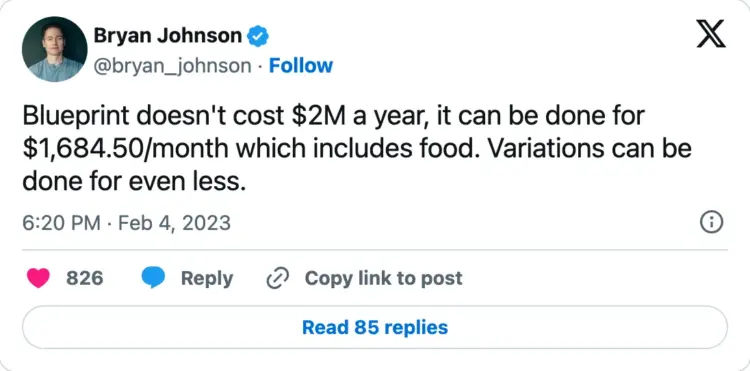
The widely repeated figure is $2M a year, and Johnson himself has pushed back on it. That number reflects his full experimental spend, including a sizeable medical team and therapies most people will never touch. Back in a February 2023 tweet, he said Blueprint could be done for $1,684.50 a month including food, with variations for even less (source). That figure is now several years old, so treat it as a rough historical benchmark rather than today’s price.
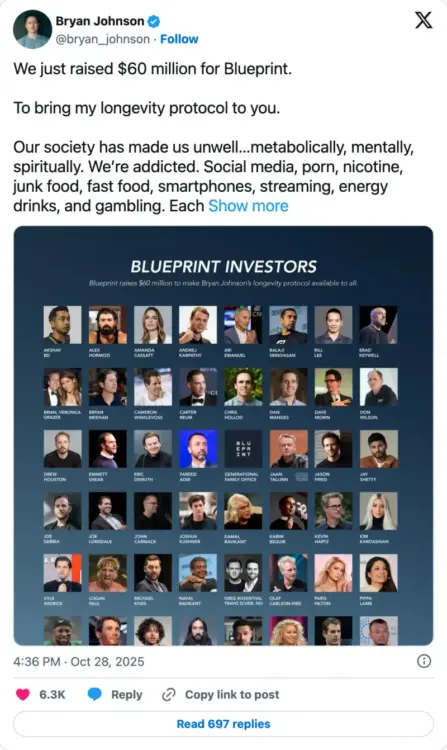
Blueprint also launched a biomarker panel at $365 a year, and raised $60M in October 2025 to bring the protocol to a wider audience (source).
Does It Actually Work?
Author’s Note: Blueprint is, scientifically, an n=1 experiment. There’s no randomized trial on the bundle, and no way to isolate which intervention caused which result. Bryan Johnson’s biomarkers come from his own testing, and his abandonment of plasma transfusions, growth hormone and rapamycin shows that even he couldn’t always tell what was working.
Critics make a fair point that’s easy to lose under the more exotic therapies. Exceptional sleep, exercise and diet alone could plausibly account for most of his results. The American Council on Science and Health has characterised the project as confusing correlation with causation while promoting interventions that range from well-supported to highly speculative (source).
That’s not a reason to dismiss the whole thing. The foundational layers, sleep, movement, whole-food diet, are exactly the parts with the strongest evidence and the lowest cost. The further up the stack you go, the thinner the evidence gets and the more it depends on infrastructure ordinary people don’t have.
Bryan Johnson’s own advice for anyone, regardless of budget, lands on the cheap end of his own protocol. His repeated line is that the most powerful things in health are free.
- Start with your bedtime: Sleep’s free, and it’s the foundation. Set a consistent bedtime and protect it.
- Move 30 minutes a day: And get up to move every 30 minutes through the day.
- Eat a Mediterranean-style diet: Whole foods, less of the convenience-store aisle.
- Build systems, not willpower: Make commitments ahead of time rather than relying on in-the-moment discipline.
It’s a more modest message than the $2M headline suggests. That foundation, sleep, exercise and diet, costs nothing.
Blueprint Protocol Changes
Blueprint isn’t fixed. Johnson adjusts it as his data changes, and a few things he used to do have since been dropped or reorganized.
Until late 2023 his morning drink was a blend he called the “green giant,” made from cocoa flavanols, amino acids, cinnamon, collagen peptides, spermidine in the form of chlorella powder, and creatine (source). He batched it monthly, multiplying the daily proportions by 30 into one large container and scooping five tablespoons each morning.
He discontinued it in October 2023, describing the change as a reorganization rather than a reversal, with the amino acids dropped since his protein intake already covered them, and the cocoa flavanols, collagen peptides and creatine folded into Nutty Pudding (source).
He has also experimented with compounds that no longer appear on his published protocol, including NDGA, which he began taking at 50mg daily in June 2023 (source) and lithium. He hasn’t announced stopping NDGA or lithium. They have simply stopped appearing on the protocol he publishes, which may mean he no longer takes them.
Roundup
Blueprint is best understood as a layered system rather than a supplement list. It starts with sleep, then exercise, then three plant-based meals all finished by noon, then a defined supplement stack, with skin, hair and oral routines tracked alongside everything else. Prescriptions and advanced therapies like sauna, HBOT and light therapy sit at the top, and those are the parts tied to Bryan Johnson’s own medical team and budget. The order is the useful part, because most of the benefit sits at the bottom of the stack, which is also the part that costs nothing.
If you’ve got any questions or thoughts on Bryan Johnson’s Blueprint Protocol, please leave them below in the comments.
Further Reading
If you found this useful, you might also enjoy these:
- Andrew Huberman’s Supplements List: What the neuroscientist takes and why, with doses.
- David Sinclair’s Supplements: The Harvard aging researcher’s stack, including his approach to NMN and metformin.
- Rhonda Patrick’s Supplement List: What the biochemist takes and why, with brands.
- Stacy Sims’ Supplement List: A supplement strategy tailored to women’s performance and hormonal health.
FAQs
Blueprint is the structured anti-aging system Bryan Johnson began in October 2021 to slow biomarker measures of his biological age. It layers sleep, exercise, a plant-based diet, a defined supplement stack, prescription medications for his own conditions, and advanced therapies, with everything tracked through regular biomarker testing.
Bryan Johnson has said in 2023 that the full protocol can be done for about $1,684.50 a month including food, and variations for less (source). A pared-down, evidence-based version covering vitamin D3, omega-3, magnesium glycinate and creatine can run under $100 a month. His own total spend of $2M a year reflects a personal medical team and experimental therapies, not the protocol itself.
He eats three timed meals totalling about 2,250 calories and 130g of protein, all finished by noon, then nothing more that day. The meals are a morning supplement stack, a large vegetable bowl he calls Super Veggie, and a third whole-food meal, all plant-based by his personal choice.
His core stack includes Blueprint Essentials, Advanced Antioxidants, ashwagandha and rhodiola, EPA/DHA 800mg, creatine 7.5g total, collagen peptides 20 to 30g, and his Longevity and Metabolic protein blends, all taken in the morning (source). He took rapamycin for nearly five years before stopping, citing side effects including lipid abnormalities and elevated blood glucose.
Yes. Blueprint publishes a separate women’s protocol, presented by CMO Kate Tolo, that adjusts training and supplements by menstrual cycle phase and life stage (source). It emphasises strength training, regular blood work, and pelvic floor exercises across all stages.
No, he doesn’t drink at all, mainly because of the caloric cost and because alcohol near bedtime disrupts his sleep (source). He’s clear that Blueprint itself doesn’t forbid alcohol and considers moderate drinking reasonable for others.
He goes to bed at 8:30 PM and wakes at 5 AM, aiming for eight hours and a consistent schedule within about 30 minutes each night. He finishes eating by noon so he has roughly eight and a half hours of digestion before bed (source).
Johnson doesn’t report a single “biological age” so much as a dashboard of markers. The clearest is his skin, which he measures at roughly 9 years younger than his chronological age, a skin age of 39 at 48 (source). He also reports a range of biomarkers in the 98th and 99th percentiles, including muscle, bone density and fertility. These are all self-reported figures from his own testing rather than independently verified results.
Thumbnail image: “Bryan Johnson 2026” by M Robertson, modified, licensed under CC BY 4.0.
Disclaimer: The above information is for research and educational purposes only and not a substitute for professional medical advice. See full medical disclaimer.
Note: We have no affiliation with Bryan Johnson - this article is based on publicly shared information.