Mark Hyman’s 10-day detox diet strips out sugar, grains, beans, dairy, gluten, alcohol and caffeine for ten days, then adds them back one at a time to see what your body reacts to.
In this article we’ll look at the three pillars of the program, the doses and portions Mark Hyman gives, the outcome numbers he quotes, and where the independent evidence sits.
TLDR: Mark Hyman 10-Day Detox Diet Plan
- The food rules: Sugar, all grains, most beans, dairy, gluten, alcohol, coffee and seed oils are cut for ten days. The plate that replaces them is three quarters non-starchy vegetables with 30 to 40 grams of protein, and generous fats from avocado, olive oil, nuts and seeds.
- Sleep and timing: A 12 to 14 hour overnight fast, nothing within three hours of bed, a fixed bedtime, screens off early, and a bedroom at 65 to 68°F.
- The supplement stack: A multivitamin, magnesium at 300 to 600mg, vitamin D at 3,000 to 5,000 IU, and fish oil, with NAC and vitamin C on top of that.
- The results he reports: A 600-person group he ran reported 4,000 lbs lost in 10 days and a 62% drop in symptoms. These are his program’s self-reported figures, not a controlled trial.
- His personal practice: He repeats the reset two or three times a year and tracks his blood sugar with a continuous glucose monitor, neither of which is in the public instructions.
- Reintroducing food: One food group at a time, three days each, because a mixed reintroduction tells you nothing.

Pillar One: Food
The food rules are the bulk of the program, and they’re subtractive before they’re additive. For ten days the following come out (source):
- Sugar and artificial sweeteners are removed: A little monk fruit or stevia is tolerated.
- Grains: All of them, including quinoa, buckwheat, oats and rice.
- Beans and legumes: Green beans, green peas, snap peas and non-GMO soy stay in. The rest come out.
- Dairy: Grass-fed butter and ghee are allowed. Everything else goes, including milk products from sheeps and goats.
- Alcohol and coffee: Both out. Green tea is fine.
- Industrial fats: Canola, soybean, sunflower, safflower, peanut oil, margarine and vegetable shortening.
- High-glycemic fruit: Including bananas, pineapple, melon, grapes, cherries, peaches and pears.

What replaces them is a plate Mark Hyman describes in fairly exact proportions. Three quarters of it is non-starchy vegetables. He then has a meal, in which the protein is 30 to 40 grams (source). He is not fussy about which protein, so chicken, fish, eggs, tofu and beans all work. Fat is what keeps the meal filling, and that comes from avocado, olive oil, nuts or seeds.
Two categories get portion caps rather than a ban. Sweet potato, winter squash, carrots and pumpkin are capped at roughly half a cup a day, and low-glycemic berries get the same treatment (source).
He says this isn’t calorie counting, and that you can eat as much as you want of the allowed foods. But capping starchy vegetables and berries at half a cup a day is, in effect, a carb limit.
One caveat sits specifically under the gluten rule. There’s no test that confirms gluten sensitivity in people without coeliac disease1Non Celiac Gluten Sensitivity and Diagnostic Challenges | Casella et al. | 2018 | Gastroenterology and Hepatology from Bed to Bench, so it’s diagnosed by trial and error. And one study2Non-Coeliac Gluten Sensitivity: Piecing the Puzzle Together | Biesiekierski & Iven | 2015 | United European Gastroenterology Journal suggests the relief people feel from cutting gluten actually comes from cutting other hard-to-digest carbs in wheat, not gluten itself. So if you feel better without gluten during the ten days, that alone doesn’t prove gluten was the problem.
Author’s note: The word “detox” suggests this diet helps your liver or kidneys flush out toxins. That specific claim isn’t backed by evidence. Cutting sugar, refined starch, alcohol and processed food for ten days can still be worth doing, it just doesn’t need the detox label to justify it.
Hear him walk through the plate proportions here. This clip starts at ≈2:22.
The Breakfast Rule
Breakfast carries more weight in his framing than any other meal. His position is that starting the day on sugar or flour sets off an insulin, cortisol and adrenaline cascade that drives cravings for the rest of the day, and that protein and fat at the first meal is what prevents it. A nut and seed shake, or an omelette with avocado and olive oil, is the shape he points to (source).
Pillar Two: Daily Habits
The second pillar is when you eat and when you sleep. Mark Hyman treats the timing rules as roughly equal in importance to the food list (source).
- Overnight fast: 12 to 14 hours between dinner and breakfast. Dinner at six, breakfast at eight.
- No late eating: Nothing within three hours of bedtime, and no post-dinner snacking.
- Fixed bedtime: The same time every night for the ten days.
- Screens off: One to two hours before bed, or blue-blocking glasses.
- Bedroom conditions: Dark, and 65 to 68°F.
- Wind-down: Meditation, breath work, stretching, journaling or a gratitude practice.

Nothing in that list is unusual, granted, it’s all easier said than done. The 12-14 hour window is the mildest form of time-restricted eating, and readers who want the broader picture on fasting windows may find our fasting tips piece useful, or Jason Fung’s approach in The Obesity Code, which arrives at similar timing rules from a different direction. The sleep protocol also overlaps closely with Andrew Huberman’s routine.
Pillar Three: Supplemental Support
Mark Hyman’s argument for supplementing during the reset rests on two figures he cites regularly. He puts the share of Americans deficient in one or more nutrients at around 90%, and the share low or deficient in magnesium at around 45% (source).

The free version of the program calls for four things. A broad foundational multivitamin capsule sits at the base, alongside magnesium for nervous-system relaxation at night, with magnesium citrate at 300-600mg per day where the diet change causes constipation.
Vitamin D comes next, at 3,000-5,000 IU, which he treats as the range for what he calls optimal levels rather than the much smaller amount needed simply to avoid deficiency.
Fish oil is optional, for omega-3s.
The paid program bundles six products, all sold through his own store: O.N.E Multivitamin, Omega 3 Rejuvenate, Vitamin D Supreme, N-Acetyl L-Cysteine, Buffered Ascorbic Acid (vitamin C), and Magnesium Glycinate, with magnesium citrate offered separately for digestive support (source).
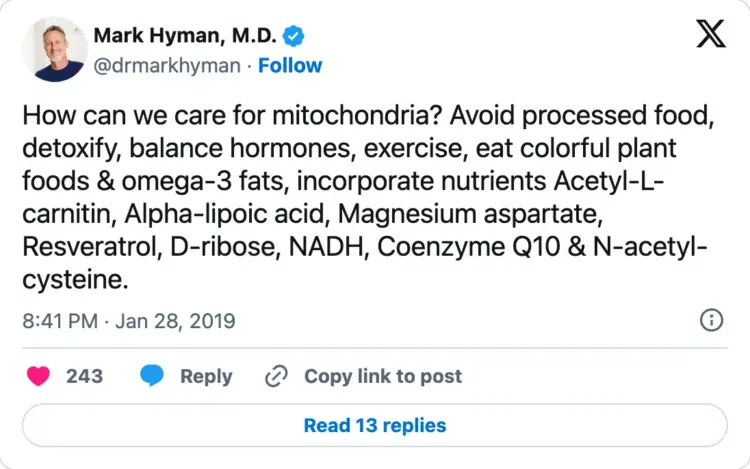
Source: @drmarkhyman on X
The magnesium claim is the one with the most support behind it. A randomised trial3Magnesium Bisglycinate Supplementation in Healthy Adults Reporting Poor Sleep: A Randomized, Placebo-Controlled Trial | Schuster et al. | 2025 | Nature and Science of Sleep in 155 adults with poor sleep found 250mg per day of magnesium bisglycinate improved sleep-quality scores significantly more than placebo over four weeks, though the effect was small. The same trial found 79% of US adults fall below the RDA for magnesium, roughly in line with his 45% figure, though not an exact match.
The detox stack is built for ten days, not for good. What Hyman takes year round is a shorter and more conventional list, which we cover in Mark Hyman’s supplement list.
Mark Hyman 10 Day Detox Diet Statistics
The headline figures attached to the program come from Mark Hyman’s own tracking rather than from a published trial, and they’re worth reading with that in mind.
- 600-person group: 4,000 lbs of total weight loss over 10 days, blood sugar down 18 points, blood pressure down 11 points, and a self-reported 62% drop in symptoms.
- Five-day groups: Symptom scores dropped 70% (source).
- Program figures: 69% less bloating, 76% less brain fog, 85% less heartburn, and about 7 lbs of average weight loss (source).
These numbers come from Hyman’s own program tracking, using a symptom questionnaire he built for his practice, not a peer-reviewed trial. There’s no control group or independent replication, so they show what participants reported, not proof of what the diet caused.
Watch him run through the 600-person group’s numbers here.
What Mark Hyman Does Himself
Two things separate his personal practice from what the public program asks for.
- He repeats the reset two or three times a year, rather than treating it as a one-off (source).
- He tracks his own blood glucose with a continuous glucose monitor (source).
Neither is part of the ten-day detox diet instructions.
Coming Off The Detox
Reintroducing food after the ten days matters as much as the elimination itself, and Mark Hyman is blunt that getting it wrong causes trouble. Coming off an elimination diet straight into a mixed meal can produce a sharper symptom rebound than the reader had before starting, because the reaction returns to a system that’s been quiet for ten days.
The protocol is one food group at a time, three days each, before moving to the next (source). Pizza is the example he uses of what not to do, since it reintroduces gluten and dairy simultaneously and tells you nothing about which one caused the reaction. His usual order starts with gluten, then dairy, then other grains.
For anyone continuing past ten days, he describes his own long-term pattern as the pegan diet, which loosens the rules to allow gluten-free grains and some grass-fed dairy. On listening to your own reactions rather than his instructions, his line is that “the smartest doctor in the room is your own body”.
Catch the reintroduction rule and his “smartest doctor in the room” line here. This clip starts at ≈21:35.
Roundup
Mark Hyman’s 10-day detox diet is a short, fairly strict elimination protocol with a sleep and timing layer attached and a supplement stack sold alongside it. The food and habit rules are conventional and, as Mark Hyman notes, low-risk for most healthy adults. The parts to hold more loosely are the outcome percentages, which are self-reported program data, and the detox framing itself, which claims a mechanism the food rules don’t need.
If you’ve tried the ten days, or you’re weighing it up, please leave your questions and experiences in the comments below.
Further Reading
If you found this post on Mark Hyman’s 10-Day Detox Diet helpful, you may also like:
- Gary Brecka’s Diet – His 30-30-30 protocol and supplement stack, a routine-first approach rather than a food-elimination one.
- Dr Rhonda Patrick Diet – A nutrient-density-first approach built around polyphenols and fasting windows rather than an elimination phase.
- Joe Rogan’s Diet – A carnivore-leaning approach at the opposite end of the spectrum from Hyman’s plant-heavy plate.
- Peter Attia Diet – What the longevity physician eats day to day and why, with a protein-first approach that’s less restrictive than Hyman’s elimination rules.
FAQs
Non-starchy vegetables fill three-quarters of the plate. Each meal has 30 to 40 grams of protein, and that can be chicken, fish, eggs or tofu. Fats in this meal come from avocado, olive oil, nuts and seeds. Grains, dairy, gluten, most beans, sugar, alcohol and coffee are cut out for the ten days (source).
He points to magnesium citrate at 300-600mg per day for constipation during the reset, alongside magnesium glycinate for nervous-system relaxation at night (source). A separate randomised trial found 250mg per day of magnesium bisglycinate modestly improved sleep quality over placebo.
Yes. He says he repeats it two to three times a year, rather than treating it as a one-time program, and tracks his own blood glucose with a continuous glucose monitor alongside it (source).
The food rules themselves, cutting sugar, refined starch, alcohol and processed food while eating more vegetables and protein, are low-risk for most healthy adults. The main caution is coming off it carelessly: reintroducing several eliminated foods at once can trigger a sharper symptom rebound than before starting.
One food group at a time, three days each, rather than mixing several back in at once. Pizza is the example Mark Hyman gives of what not to do, since it reintroduces gluten and dairy simultaneously and won’t tell you which one caused a reaction (source).
Thumbnail image: “Mark Hyman M.D., Co-Founder and Chief Medical Officer Function Health” by Stephanie Williams for Mark Hyman M.D., co-founder and Chief Medical Officer of Function Health, modified, licensed under CC BY-SA 4.0.
References
- 1Non Celiac Gluten Sensitivity and Diagnostic Challenges | Casella et al. | 2018 | Gastroenterology and Hepatology from Bed to Bench ↩︎
- 2Non-Coeliac Gluten Sensitivity: Piecing the Puzzle Together | Biesiekierski & Iven | 2015 | United European Gastroenterology Journal ↩︎
- 3Magnesium Bisglycinate Supplementation in Healthy Adults Reporting Poor Sleep: A Randomized, Placebo-Controlled Trial | Schuster et al. | 2025 | Nature and Science of Sleep ↩︎
Disclaimer: The above information is for research and educational purposes only and not a substitute for professional medical advice. See full medical disclaimer.