In this article we’ll look at which peptides Johnson actually uses, and the framework that decides whether one stays or goes.
Bryan Johnson’s view is that almost nobody is using peptides correctly. You can search for biohacker peptide stack and you’ll find dozens of protocols traded like recipes, most of them copied from someone who copied them from someone else.
His core argument is simple. An injection without a biomarker to measure against is a shot in the dark. You feel like you’re doing something. You may be doing nothing, or worse, you might be affecting your health negatively.
TLDR: Bryan Johnson’s Peptide Plan
- The Framework First: He treats every peptide as a closed loop. Take it, measure a biomarker, adjust. Without the measurement, you’re dosing on feelings.
- What He Currently Takes: The Blueprint Peptide Serum, a topical hair product carrying eight biomimetic peptides applied daily to the scalp.
- The Experiments He Stopped: Cerebrolysin felt like the best cognitive boost he’d ever had but his formal markers showed nothing. Epithalon and Thymulin were announced in 2024 and have since disappeared from his protocol.
- The One in Progress: As of 2025 he’s stacking Tirzepatide with CJC-1295 DAC on a theory that their opposite side effects might cancel out. Results pending.
- GLP-1s: In July 2026 he added six to his prescription platform and called the class a possible longevity drug.
- The 0.64 Connection: His lowest-ever aging speed might trace to a peptide regimen or his follistatin gene therapy. He hasn’t separated the two.
- Measurement Is The Affordable Part: Most of his stack is out of reach, but the bloodwork discipline that makes any of it meaningful is not.
- BPC-157: He’s personally experimented with it but it is not in his current disclosed protocol. Much of what circulates online is speculation.
- Collagen Peptides: Worth a mention separately as a low-risk daily staple, though not a bioactive peptide in the same category as the rest.
Bryan Johnson’s Peptide Philosophy
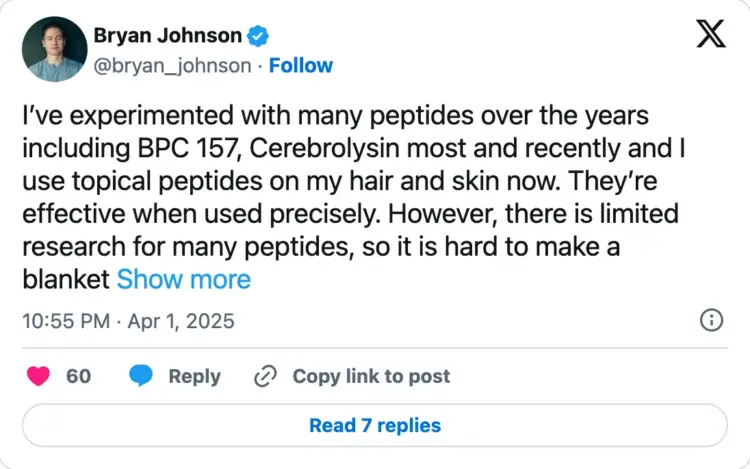
Source: x.com/bryan_johnson
Before any compound, Johnson’s position is that the basics come first. Sleep, nutrition and exercise are the foundation, and a peptide stacked on top of poor sleep is solving the wrong problem.
The framework itself is a loop. Take the peptide, measure a relevant biomarker, then adjust based on what the data says.
Watch the full video here.
He pushed back on the idea that peptides are only for the wealthy or the elite. The real barrier isn’t access, it’s measurement. Without biomarkers, you can’t tell a working intervention from an expensive placebo. (source)
There’s a related principle he returns to often: more is not better. He once doubled his iodine dose from 125 mcg to 250 mcg and watched a marker move out of range. The lesson generalises. A bigger dose of a peptide is not automatically a better one, and the only way to know is to measure. The same measure-and-adjust logic runs through his full supplement list.
Watch the full episode here. This segment starts at ≈6:01.
Which Peptides Bryan Johnson Currently Takes
His active protocol currently includes one topical peptide product applied daily to the scalp.
Blueprint Peptide Serum

This one is topical, not injected. The Blueprint Peptide Serum is a hair product applied to the scalp, and Johnson combines it with a red light cap.
Johnson has said it carries eight biomimetic peptides (source):
- EGF (epidermal growth factor)
- Thymosin-β4
- SCF (stem cell factor)
- hGH (a growth hormone peptide)
- VEGF (vascular endothelial growth factor)
- PDGF (platelet-derived growth factor)
- Follistatin
- GHK-Cu (copper tripeptide-1)
These are signalling peptides associated with hair follicle activity and blood supply to the scalp. Because it’s topical rather than systemic, the risk profile differs from an injectable. The human evidence for most of these as hair treatments is early.
GHK-Cu also shows up in an injectable form from Live Vital through a licensed pharmacy.
The Experiments He Stopped
Some of the most useful material in Johnson’s peptide history is what he abandoned. Four cases stand out.
Epithalon and Thymulin
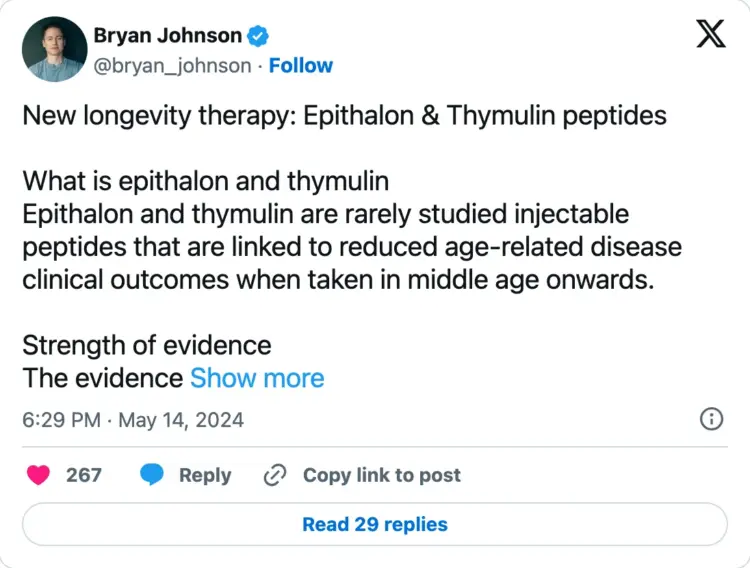
Source: x.com/bryan_johnson
Here the protocol turns injectable. Johnson uses Epithalon and Thymulin together, 10mg of each via intramuscular injection, for five consecutive days, every six months (source). He started this in 2024 and we haven’t heard anything since in 2 years, so we’re assuming the experiment was stopped. If this turns out to be incorrect,we’ll update the article.
Epithalon is a synthetic peptide studied mainly for telomere effects. In cell lines and animal models it has shown telomerase activation and telomere elongation. Johnson points to a roughly 66% all-cause-mortality reduction figure, while acknowledging openly that the compound is barely studied. He takes it because the risk-reward maths made sense to him given thin data, not because it’s settled science.
Author’s Note. The 66% figure traces back to essentially one Russian study, and there is no large-scale independent human RCT replicating it. Epithalon’s telomere effects have been seen in cell lines and animals, but the leap from those models to a mortality benefit in humans is not supported by the kind of evidence you’d want before drawing conclusions. Thymulin’s human data is similarly limited; it’s been studied mainly in immune and animal contexts rather than in the longevity application it’s paired with here.1Peptide bioregulation of aging: results and prospects | Anisimov & Khavinson | 2010 | Biogerontology
Cerebrolysin
Source: x.com/bryan_johnson
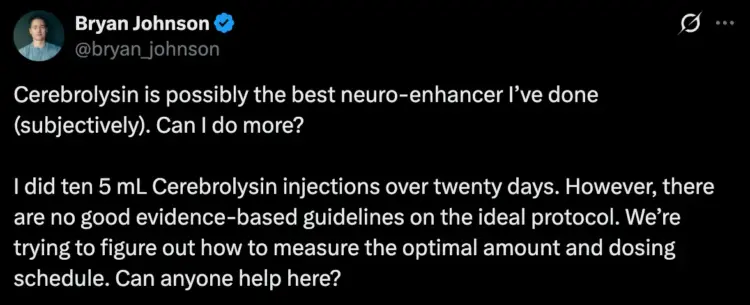
Cerebrolysin is a mix of peptides derived from pig brain tissue, used in some countries for stroke and dementia. Johnson’s experiment ran at 5 mL by intramuscular injection every other day for 20 days, repeated every six months (source).
Subjectively, he rated it extraordinarily. He described it as the best thing he’d ever done for mental clarity, better than coffee, better than tea, better than anything (source).
Objectively, his formal cognitive markers showed no measurable effect. He’s said he plans an MRI at the six-month mark to look further. This is the philosophy in miniature. The subjective high was real to him, and the data didn’t back it.
A Cochrane review found Cerebrolysin offers no meaningful advantage over standard therapy following stroke. A strong subjective experience is exactly the kind of signal the biomarker loop exists to check, because feeling sharper and being measurably sharper are not the same thing.2Cerebrolysin for acute ischaemic stroke | Ziganshina, Abakumova & Hoyle | 2020 | Cochrane Database of Systematic Reviews
Catch the full clip here.
CJC-1295
CJC-1295 is a growth-hormone-releasing peptide. On its own, the experiment went badly.
According to analysis of his published experiment data (newaira.co), his growth hormone rose roughly eightfold. But IGF-1, the downstream hormone that carries most of GH’s actual benefit, didn’t move. Alongside that:
- Fasting blood glucose rose
- Insulin resistance increased
- REM sleep declined substantially
He described feeling continuously tired and never fully recovered, like a low-grade jet lag. He discontinued after two doses. Raising GH without an IGF-1 response means the biological payoff never arrived.
Paired with Ipamorelin, CJC-1295 is offered as a prescribed telehealth protocol by clinics such as Live Vital.
CJC-1295 plus Pamirelin
Bryan Johnson later tried CJC-1295 stacked with Pamirelin. He ran it at a third of the dose, on a Saturday morning before a workout, and it still wrecked his sleep. He said he had a hangover for about two days afterward.
His verdict was short: not doing that anymore.
Catch the full episode here. Jump to ≈12:24 for this segment.
Experiments In Progress
As of 2025, Johnson is testing CJC-1295 again, this time stacked with Tirzepatide (the GLP-1 drug sold as Mounjaro and Zepbound). (source)
The theory is built on opposing side effects. Tirzepatide tends to raise heart rate but improves blood sugar. CJC-1295 calms the nervous system but disrupts glucose. The bet is that the opposite effects partly cancel while the benefits stack (source).
He’s running it as a four-week escalating protocol with weekly blood tests, a continuous glucose monitor, and sleep tracking. The two earlier CJC experiments are the reason the monitoring is this dense. Whether the cancellation theory holds is an open question. The results aren’t in.
Tirzepatide is a prescription GLP-1, so unlike the other peptides here it’s widely available through telehealth providers like Shed.
Watch the full breakdown here.
GLP-1s As A Longevity Drug
In July 2026 Bryan Johnson added six GLP-1s to Immortals by Bryan Johnson, his prescription platform, and called them more than a weight loss drug. His words were that GLP-1s “might be a longevity drug” (source).
The trigger was a trip to Australia. A seven hour time zone shift brought back what he calls food noise, the constant pull toward eating when there’s no hunger behind it. He’d been there before. Years ago he was 60 lbs overweight and couldn’t stop himself overeating at night.
There’s real physiology under that. Short sleep alone is enough to move the hormones that govern appetite. In one controlled study, two days of restricted sleep dropped leptin by 18%, raised ghrelin by 28% and left participants reporting 24% more hunger, with the sharpest rise in cravings for calorie-dense carbohydrates3Brief communication: Sleep curtailment in healthy young men is associated with decreased leptin levels, elevated ghrelin levels, and increased hunger and appetite | Spiegel et al. | 2004 | Annals of Internal Medicine. Long haul travel disrupts the same system. A GLP-1 acts on the same appetite signalling from the other direction.
Bryan Johnson gave three reasons for the longevity label, all of them effects beyond weight loss:
- Lower blood pressure
- Improved blood sugar regulation
- Reduced lipid levels and inflammatory markers
The cardiovascular evidence is the strongest of the three. In the SELECT trial, 17,604 adults with heart disease and a BMI over 27 took Semaglutide or placebo. None of them had diabetes. Major adverse cardiac events fell from 8.0% to 6.5%, a 20% relative reduction4Semaglutide and Cardiovascular Outcomes in Obesity without Diabetes | Lincoff et al. | 2023 | New England Journal of Medicine. The non-diabetic population is what makes it interesting, because it separates the heart benefit from glucose control.
The Six GLP-1s He Added
Four are brand name:
- Zepbound (KwikPen), Tirzepatide
- Wegovy injections, Semaglutide
- Wegovy tablets, oral Semaglutide
- Foundayo tablets, Orforglipron
Two are compounded:
- Personalised Tirzepatide injections
- Personalised Semaglutide injections
Foundayo is the odd one out. Everything else on that list is a peptide, but Orforglipron is a small molecule, a different class of drug built to hit the GLP-1 receptor without a peptide backbone. That’s why it survives digestion and can be taken at any time of day with or without food (source). Oral Wegovy is a peptide, so it has to go down in the morning on an empty stomach with a wait before eating or drinking.
The Compounded Options
The wording on the last two peptides isn’t accidental.
Semaglutide and Tirzepatide are no longer on the FDA shortage list. Once a drug leaves that list, compounders lose the exemption that let them make copies of it.
What’s left is narrow. A pharmacy can still compound these where there’s a documented individual medical need for a formulation that isn’t a copy, such as an allergy to an inactive ingredient or a concentration that isn’t sold commercially. Cost savings on their own don’t qualify. In April 2026 the FDA went further and proposed dropping all three GLP-1s from the 503B bulks list entirely, finding no clinical need for outsourcing facilities to compound them (source).
Compounded GLP-1s haven’t disappeared. The route just runs through a prescriber who documents why. Hone Health is one such prescriber and requires a full blood panel before writing the prescription. It is the same model reputable telehealth providers such as SHED work on with physician supervised compounded Semaglutide and Tirzepatide.
The 0.64 Aging Speed Connection
Bryan Johnson has mentioned his lowest-ever DNA methylation aging speed: 0.64 (source). He described it as about as low as humanly possible in this time and place.
Aging speed here is a methylation-clock estimate of how fast someone is biologically aging relative to calendar time. A score below 1.0 means slower than real time.
Two candidate causes are on the table for that reading:
- A peptide regimen
- His follistatin gene therapy
He hasn’t yet teased apart which one is responsible, and it may be neither in isolation (for the source, see ~07:00–08:00). The honest version is that something in that window moved the number, and the experiment to isolate it hasn’t been run.
Listen to the full episode here. This segment begins at ≈11:11.
What You Would Actually Need To Measure
Bryan Johnson’s peptide plan rests on measuring everything before and after. The 0.64 figure only means something because there are years of baseline behind it.
Most of his stack is out of reach. The measurement is not. Fasting glucose, ApoB, testosterone and a thyroid panel are what tell you whether anything you try did anything at all, and a credible provider such as Hone Health will run all of them from a single draw and have a physician talk you through the results.
BPC-157 and The Speculation Problem

BPC-157 comes up constantly in connection with Johnson, mostly from fans rather than from him. Here’s what’s actually confirmed.
Bryan Johnson has said he’s personally experimented with BPC-157 (source). It is not in his current disclosed protocol.
The research base is limited, and the FDA does not approve BPC-157 for human use. Whilst the research is limited, it is potentially the most widely taken bioactive peptide (GLP-1s aside), particularly in respect to injury healing.
Collagen Peptides
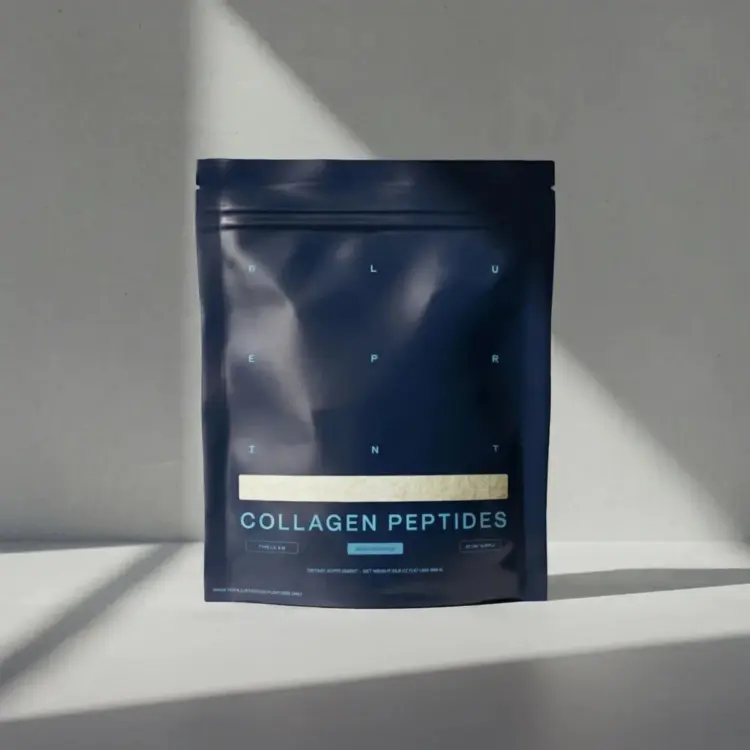
Johnson takes 20 to 30g of collagen peptides daily, paired with vitamin C, per his Blueprint protocol. The vitamin C pairing matters because it’s a cofactor in collagen synthesis.
Collagen is the least exotic peptide on this list. It’s well tolerated, oral, and the downside risk is low. Most reputable brands sell hydrolysed collagen in the same form Johnson uses, typically Type I and III, often with added vitamin C or taken alongside a separate vitamin C supplement.
Here are some common examples of collagen peptides:
Scroll right for full table →
| Product | Best For | Why It Fits |
|---|---|---|
| Sparkle Wellness VERISOL Collagen Peptides | Bryan Johnson-style collagen + Vitamin C stack | Includes Vit C and hyaluronic acid alongside collagen peptides, making it more than a basic collagen powder. Rhonda Patrick uses VERISOL collagen |
| Physician’s Choice Collagen Peptides | Collagen + gut health support | Combines collagen peptides with probiotics and digestive enzymes. |
| Nutricost Collagen Peptides | Budget-friendly daily collagen | Simple, affordable collagen peptide powder with no extra ingredients. |
Roundup
Bryan Johnson’s peptide story is less about which compounds he uses and more about how he decides. The collagen and the hair serum are low-stakes daily picks. The injectables are bets placed on thin evidence with the explicit understanding that the evidence is thin.
And the failures, Cerebrolysin measured nothing and CJC-1295 produced an eightfold GH rise with no IGF-1 follow-through, are the parts that actually demonstrate the framework working. The biomarker loop is what separates an experiment from a guess, and it’s the one piece of his approach that travels regardless of what’s in the syringe.
Further Reading
If you found this useful, you may also enjoy:
- Joe Rogan’s Peptide List – A performance-driven look at the peptides one of the loudest advocates relies on, covering BPC-157, TB-500, and what he’s said about the results.
- Gary Brecka’s Peptide List – The peptides a human biologist points to, with the reasoning and targeted benefits he ties to each one.
- Andrew Huberman’s Peptides – The compounds the neuroscientist has personally taken and broken down on his podcast, from sleep peptides like Pinealon and Epitalon to repair agents like BPC-157.
- Are Peptides Legal in the UK? – Everything the 2026 MHRA rules cover, from what’s allowed for possession versus human use to how to stay compliant.
Have a question about Johnson’s peptide use, or spotted something we missed? Please leave them in the comments below.
Thumbnail adapted from a photo by Katriece Ray for Kernel via Wikimedia Commons
FAQs
Bryan Johnson’s active peptide protocol covers a topical Blueprint hair serum carrying eight peptides applied to the scalp. He also takes oral collagen peptides at 20 to 30g daily with vitamin C. (source).
Bryan Johnson has experimented with Tirzepatide stacked with CJC-1295. In July 2026 he added six GLP-1s to his prescription platform and described the class as possibly a longevity drug. He hasn’t said he’s on one continuously.
Cerebrolysin was a time-limited experiment rather than an ongoing protocol, run at 5 mL every other day for 20 days, every six months (source). He rated the subjective effect highly but measured no cognitive change in his formal markers.A Cochrane review found Cerebrolysin offers no meaningful advantage over standard therapy following stroke.
He uses 10mg each of Epithalon and Thymulin, by intramuscular injection, for five consecutive days, repeated every six months (source). He’s open that the evidence is thin: Epithalon’s telomere effects come mainly from cell-line and animal data, with no large-scale human RCT.
He has said he’s personally experimented with BPC-157 (source), but it is not in his current disclosed protocol.
Taken alone, CJC-1295 raised his growth hormone around eightfold while IGF-1 didn’t move, alongside elevated blood glucose, higher insulin resistance and a substantial drop in REM sleep, according to analysis of his published experiment data (newaira.co). He discontinued it after two doses, and a later attempt stacking it with Pamirelin wrecked his sleep even at a third of the dose.
References
- 1Peptide bioregulation of aging: results and prospects | Anisimov & Khavinson | 2010 | Biogerontology ↩︎
- 2Cerebrolysin for acute ischaemic stroke | Ziganshina, Abakumova & Hoyle | 2020 | Cochrane Database of Systematic Reviews ↩︎
- 3Brief communication: Sleep curtailment in healthy young men is associated with decreased leptin levels, elevated ghrelin levels, and increased hunger and appetite | Spiegel et al. | 2004 | Annals of Internal Medicine ↩︎
- 4Semaglutide and Cardiovascular Outcomes in Obesity without Diabetes | Lincoff et al. | 2023 | New England Journal of Medicine ↩︎
Disclaimer: The above information is for research and educational purposes only and not a substitute for professional medical advice. See full medical disclaimer.
Note: We have no affiliation with Bryan Johnson - this article is based on publicly shared information.