Eric Berg takes a daily electrolyte powder, discussing the benefits frequently.
In this article we’ll look at what he takes, why he takes it and how it compares to other electrolyte approaches.
What Berg personally takes
Berg describes his own routine:
“I take it every day. I put it in water, drink it. I might put some lemon in there, and I’ll do it like twice a day”
^ Berg on supplements for intermittent fasting
So: twice a day, with water and a squeeze of lemon, particularly before training. Specifically he’s referring to his own brand;
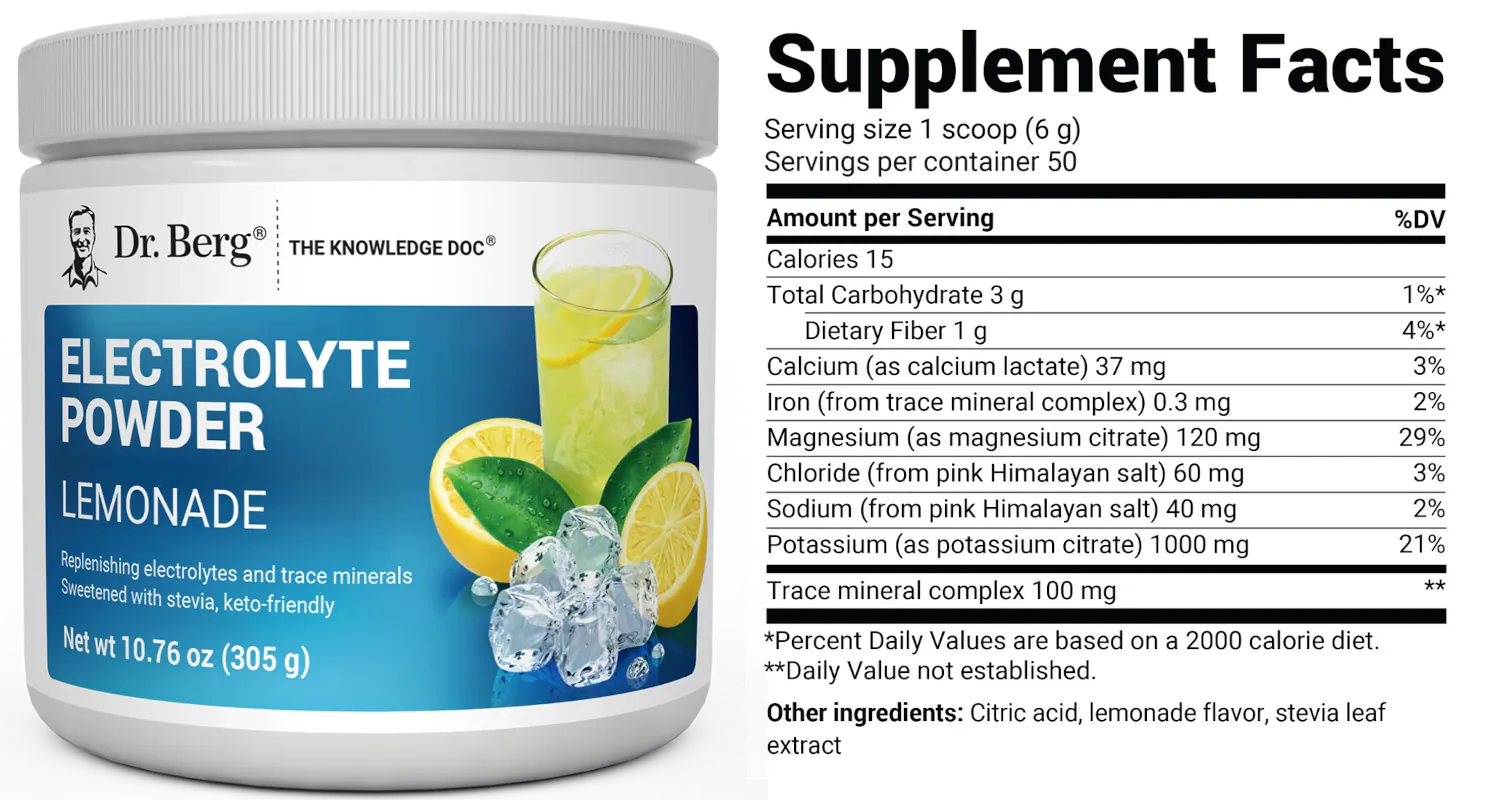
What’s in the regular powder
The focus of Berg’s product is potassium, with 1,000 mg (1g) per serving.
(This might sounds like a lot, but the recommended daily allowance of Potassium in the US is 2.6g for women and 3.4g for men).
It’s designed primarily for the keto / low-carb / fasting community rather than for athletes.
The reasoning is that low-carb eating and water fasting lower insulin, which increases excretion of sodium and potassium. Also, potassium requirements are hard to hit without fruit and starchy vegetables.
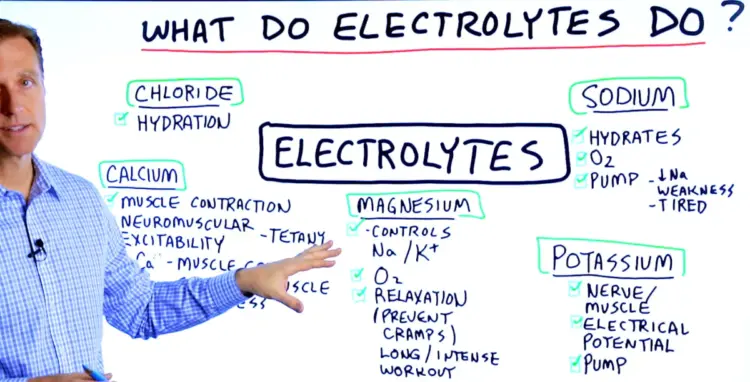
What Berg suggests for users
Berg suggests 1 scoop (6 grams) in water per day.
The focus is two-fold:
- A daily product for people whose diets fall short on potassium.
- An onboarding aid for the first 1 to 2 weeks of a ketogenic diet or intermittent fasting. Berg explains that as the body shifts away from storing glycogen-bound water and runs on ketones instead, it dumps a meaningful amount of fluid plus electrolytes (Berg’s electrolyte powder explainer, 11:09).
For those exercising, he suggests the regular formula doesn’t contain enough sodium to counterbalance what’s lost. Therefore, he suggests to either take it at different times of the day to exercise, or to add extra salt during the day to replace what’s missing.
Anyone with kidney disease, on potassium-sparing diuretics, ACE inhibitors, or ARBs, or with a history of hyperkalemia falls into the manufacturer’s “consult your physician” bucket. Potassium loadings of 1,000 mg per serving are not trivial for that group.
The sodium-to-potassium ratio debate
The formula’s most distinctive feature is also the one critics zero in on. With 1,000 mg potassium and 40 mg sodium, the ratio is roughly 1:25 sodium-to-potassium.
Independent registered dietitian Rachel Gargano puts the critique plainly:
“There is arguably a lot of potassium and very little sodium, resulting in a whopping 1:25 ratio… I typically look for a 2:1 ratio of sodium to potassium, but as you can see, these numbers are way off.”
“the formula also has a mere 40mg of sodium, which is likely too low to have an impact.”
Gargano’s framing assumes the job is hydration support – replacing what you sweat out, where sodium losses dominate.
Berg’s framing assumes a different job. His argument: most people are chronically short on potassium, not sodium, because sodium is everywhere in the modern food supply and potassium is not. He points to a 4:1 potassium-to-sodium dietary intake target as the rationale (not a description of the product’s own ratio, which is 25:1). He also notes that “when you exercise and you sweat, you primarily lose salt or sodium chloride. You don’t lose a lot of potassium, magnesium, or calcium” (Berg on electrolytes for exercise, 1:05) – a defensible generalisation, though real losses vary by individual and intensity.
As we’ll come on to, Dr Berg also has a product with higher sodium that is better suited to those frequently sweating due to exercise.
Electrolytes for Exercise
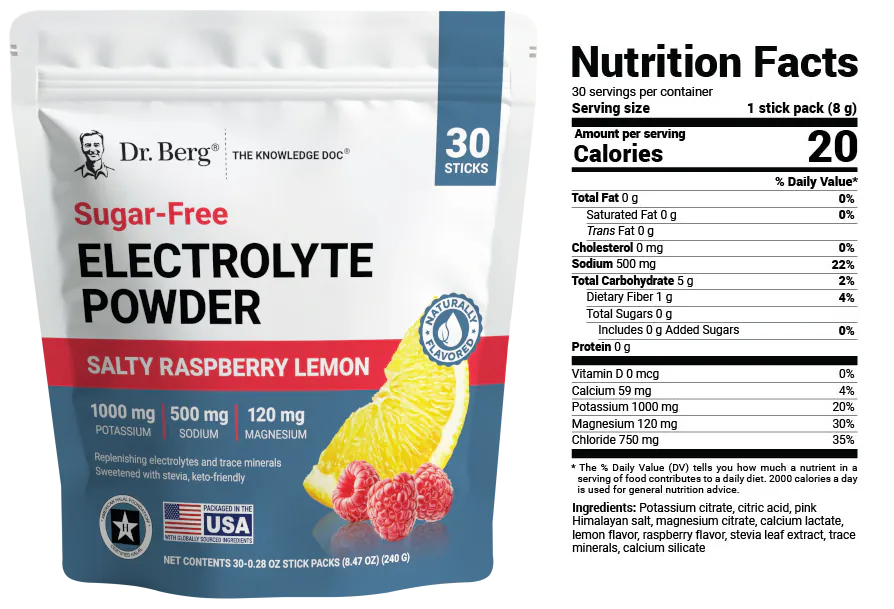
Berg’s high-sodium counterpart is sold as Electrolyte Powder Salty Raspberry Lemon – 8 g stick packs carrying the same 1,000 mg of potassium but 500 mg of sodium and 750 mg of chloride.
Berg distinguishes the two on his own channel: the regular formula as a daily mineral product for when you’re not exercising, the salty one for when you are (Berg’s electrolyte powder explainer, 7:13 and 8:24).
Roundup and Further Reading
Above we’ve covered the two main strands of Berg’s electrolyte product approaches. High potassium, low sodium, and high potassium, higher sodium.
If you have any questions or comments on Berg’s powder – or want to share what’s worked or not worked for you – please leave them below.
For further reading, please see:
- Eric Berg’s Magnesium Approach – What he Takes and Suggests
- Eric Berg’s Probiotics – His L. Reuteri Preference & Product Picks
- Intermittent Fasting Tips – the broader context for where electrolyte loss tends to bite during a fast.
Disclaimer: The above information is for research and educational purposes only and not a substitute for professional medical advice. See full medical disclaimer.