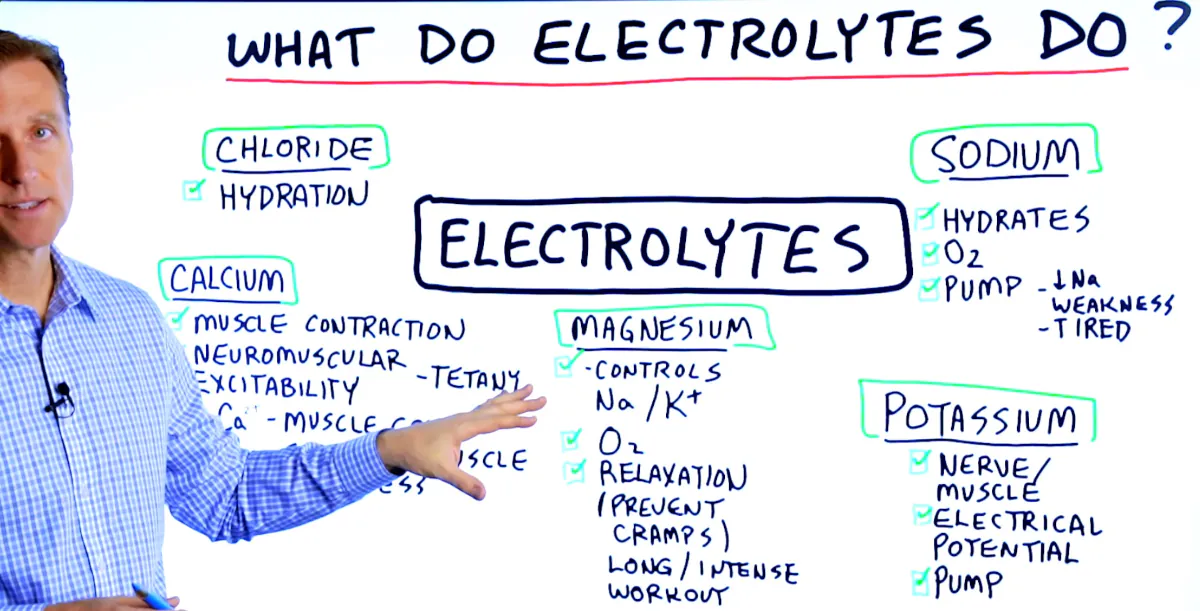
Magnesium is one of the supplements Eric Berg talks about most. He ranks it #2 in his top-5 list of “supplements that actually work”, returns to it across multiple YouTube videos, and has said on camera that it’s something he takes himself.
In this article we’ll look at the magnesium Berg takes himself and his broader thinking on the mineral (forms, dosing, deficiency, cofactors), with NIH numbers alongside where his run hot.
What Berg himself takes

Form: magnesium glycinate. He’s said it on camera at least twice:
“The magnesium that I take is magnesium glycinate.” – The Biggest Magnesium Mistakes at 4:48.
“Now let’s get to the one that I personally take. It is the most absorbable type of magnesium, and this is called magnesium glycinate.” – Best and Worst Forms of Magnesium at 5:31.
He takes it late in the day, after dinner. Sometimes capsules, sometimes powder. He frames the timing around magnesium’s circadian rhythm (levels run lowest around 6 a.m.) and says taking it at night supports sleep and pre-empts the early-morning cramps he used to get himself.
Berg hasn’t, from what we’ve seen, said exactly how many milligrams he takes. He frames 400 mg/day as a baseline rather than a target, so his own intake likely sits at or above that. But we won’t put a number on it without one.
His brand offers 2 versions:
- Magnesium Glycinate – Capsules – 120 mg per capsule
- Magnesium Glycinate – Powder – 325 mg per scoop

Something that differentiates them from other magnesium supplements on the market is that they include vitamin D3, B6 and zinc as part of the formulation. Based upon Berg’s idea that these are useful to the body in terms of utilising the magnesium correctly.
This is fine, but for people already taking these supplements in other ways, such as a multivitamin, they may preference brands that include magnesium glycinate on it’s own.
Other bands of magnesium glycinate include:
| Product | Capsules | Price | Cost per 100 mg* |
| Nutricost - Mag. Glycinate | 360 x 70 mg | $22 | $0.09 |
| NOW - Mag. Glycinate | 180 * 100 mg | $20 | $0.11 |
| California Gold Nutrition - Mag. Glycinate | 180 x 133 mg | $25 exc. coupon | $0.10 |
Then, related, he keeps coffee to “one small cup of coffee in the morning, and that’s it for the day”, relevant because he treats caffeine as a magnesium-depleter (source).
His own deficiency story is useful context for why he came to glycinate:
“I had a major magnesium deficiency and I had these cramps that would wake me right out of bed… my toes would come down like this. And I took magnesium, but it didn’t really work right away. So it took some weeks before it got better.” – source.
He also mentions restless legs in his 20s severe enough that he’d get out of bed and go for a jog in the middle of the night.
Key points Eric Berg shares about magnesium
Magnesium Deficiency

Berg’s deficiency-prevalence numbers vary across clips (40%, 50%, 66%) so we won’t pin one. The drivers he cites are consistent:
- Processed food. ~80% of magnesium is lost in processing.
- Soil depletion over the past 50 years, leaving less in produce.
- Low veg intake, which Berg pegs at ~1–1.5 cups/day on average.
- Sugar, refined carbs, alcohol, caffeine, sodas (phosphoric acid).
- Common medications: PPIs, antacids, diuretics, statins, antibiotics, birth control.
- Low stomach acid and insulin resistance blocking absorption.
- Stress.
The NIH ODS does note that many adults consume below the RDA, particularly older adults and people with GI disorders, T2D, or alcohol dependence. Clinical deficiency is rarer than Berg’s framing suggests, but inadequate intake is genuinely common.
Why he distrusts the standard blood test
Most body magnesium is intracellular or in bone. Less than 1% sits in blood serum (NIH ODS). Berg argues this is why a normal serum result can mask a sub-clinical shortfall, and pushes a symptom-led read instead.
Mainstream practice still leans on serum testing. Treat this as Berg’s argument rather than settled clinical consensus. Clinicians use serum alongside symptoms and risk factors.
Types of Magnesium Supplements

Berg cites very specific absorption percentages. These are his framing, not consensus. Mainstream comparisons say differences between bioavailable forms are smaller, and often describe the gap as negligible. With that caveat, here’s how he sorts them:
- Glycinate, ~80% per Berg. His pick. Gentle on the gut, used for sleep, anxiety, cramps, migraines.
- Threonate, ~75% per Berg. Crosses the blood-brain barrier; he reserves it for cognition, not systemic use. The brain-penetration framing is the form’s main claim in the literature.
- Malate, ~40% per Berg. Chronic fatigue, fibromyalgia.
- Citrate, ~30% per Berg. Decent absorption, but laxative at higher doses; he flags it for people prone to kidney stones because citrate binds oxalates.
- Taurate, ~20% per Berg. Cardiovascular, blood pressure, diabetes.
- Orotate, ~15% per Berg. Athletes; expensive.
- Sulfate, ~10% per Berg. Epsom salts; topical / bath use.
- Oxide, ~3–4% per Berg (he’s varied between the two on camera). The cheap form on supermarket shelves, and the one he tells viewers to skip.
NIH agrees on direction: oxide is poorly absorbed compared with chelated forms, without endorsing Berg’s specific percentages. Glycinate is generally well-tolerated and less likely to cause GI/laxative effects than citrate or oxide. Threonate has the strongest mechanistic case for blood-brain-barrier penetration and has been studied for cognition and sleep.

Dosage
Berg’s view (he holds a Doctor of Chiropractic, not a medical degree, worth flagging once because some of these run above mainstream medical guidance):
- 400 mg/day as a maintenance dose.
- ~800 mg/day as a therapeutic dose, split across the day.
- Up to 1,200–1,600 mg/day for severe cases (e.g. recurring charley-horse cramps).
- He says single doses above ~400 mg of glycinate lose absorption to urinary excretion, which is why he splits.
The NIH numbers (ODS):
- RDA: 400-420 mg/day for adult men, 310–320 mg/day for adult women.
- Tolerable Upper Intake Level from supplements/medications: 350 mg/day for adults 19+. Above this, the risk of GI side effects (loose stools, nausea, cramping) rises, and at much higher levels there’s a small but real risk of toxicity, particularly in people with reduced kidney function.

So Berg’s therapeutic numbers (800 mg, and up to 1,600 mg) sit well above the NIH UL. We’re not in a position to endorse those doses.
Anyone considering them should talk to a clinician first, especially if they’re on medications that interact with magnesium (anticoagulants, beta-blockers, NSAIDs, certain antibiotics) or have any kidney issue.
Berg’s own framing is to split doses across the day and let GI tolerance set the ceiling. He says that if a dose triggers loose stools or stomach discomfort, that’s the cue to hold and let it resolve before going higher.
Cofactors
Berg insists magnesium “won’t work” without them:
- Vitamin D. Magnesium and vitamin D activate each other; the bidirectional dependence is mainstream-supported. Berg also pushes vitamin D doses (10,000+ IU/day, sometimes much higher) that are well above mainstream guidance; we’ll leave his D numbers for another post.
- Vitamin B6. Berg says it’s needed to move magnesium into cells.
- Potassium and sodium. Particularly relevant on low-carb or keto eating, where electrolyte loss is faster.
What he ties to deficiency

Symptoms Berg associates with low magnesium:
- Muscle cramps (especially early-morning leg/foot), eye twitching, restless legs
- Insomnia, waking at 2 a.m., “wired but tired”
- Anxiety, irritability, brain fog, low stress tolerance
- Heart palpitations, raised BP, migraines
- Sugar and carb cravings
- Numbness or tingling
A 2024 systematic review by Rawji et al. found supplemental magnesium may help mild anxiety and insomnia, particularly in people with low baseline status. The authors flagged heterogeneous data and small sample sizes. Worth knowing where the evidence is and isn’t.
Realism, Berg’s own caveat
Berg’s unusually clear that magnesium isn’t drug-like. He says viewers should expect:
- ~3 days for acute cramps to settle
- ~4 weeks for insomnia
- 1–3 months for many other symptoms
- 4–6 months for arrhythmias
“You can’t create a drug effect with vitamins or minerals.” – The Biggest Magnesium Mistakes.
Related reads
- Andrew Huberman’s sleep supplements, where magnesium threonate features.
- Peter Attia on sleep, for the broader sleep-stack picture.
- Eric Berg Electrolyte Powder – What he Takes & Why
- Eric Berg’s Probiotics – His L. Reuteri Preference & Product Picks
Anything Berg-related on magnesium that you’ve heard him say and we’ve missed?
Questions or comments, please leave them below.
FAQ
Magnesium glycinate. He’s said so on camera in at least two YouTube videos (Best and Worst Forms of Magnesium, The Biggest Magnesium Mistakes), and frames it as the form that suits him for sleep, cramps and general use.
Berg suggests 400 mg/day as a maintenance dose, ~800 mg/day split for therapeutic use, and up to 1,200–1,600 mg/day for severe cases. The NIH Tolerable Upper Intake Level from supplements is 350 mg/day for adults, so his higher numbers sit well above mainstream guidance, which is one reason Berg himself frames the high end as a clinician-supervised range rather than a self-titration target.
Late in the day, after dinner. He frames the timing around magnesium’s circadian dip in the early morning and says taking it at night may support sleep.
Disclaimer: The above information is for research and educational purposes only and not a substitute for professional medical advice. See full medical disclaimer.