Joe Rogan has occasionally discussed compounds associated with cognitive performance, longevity, and biohacking. One substance that has come up in these conversations is methylene blue, a compound with a long history of medical and scientific use.
This article explores the context in which Joe Rogan methylene blue discussions have appeared and explains what methylene blue is, along with the reasons it has attracted attention in health and biohacking circles.
TLDR: Joe Rogan Methylene Blue
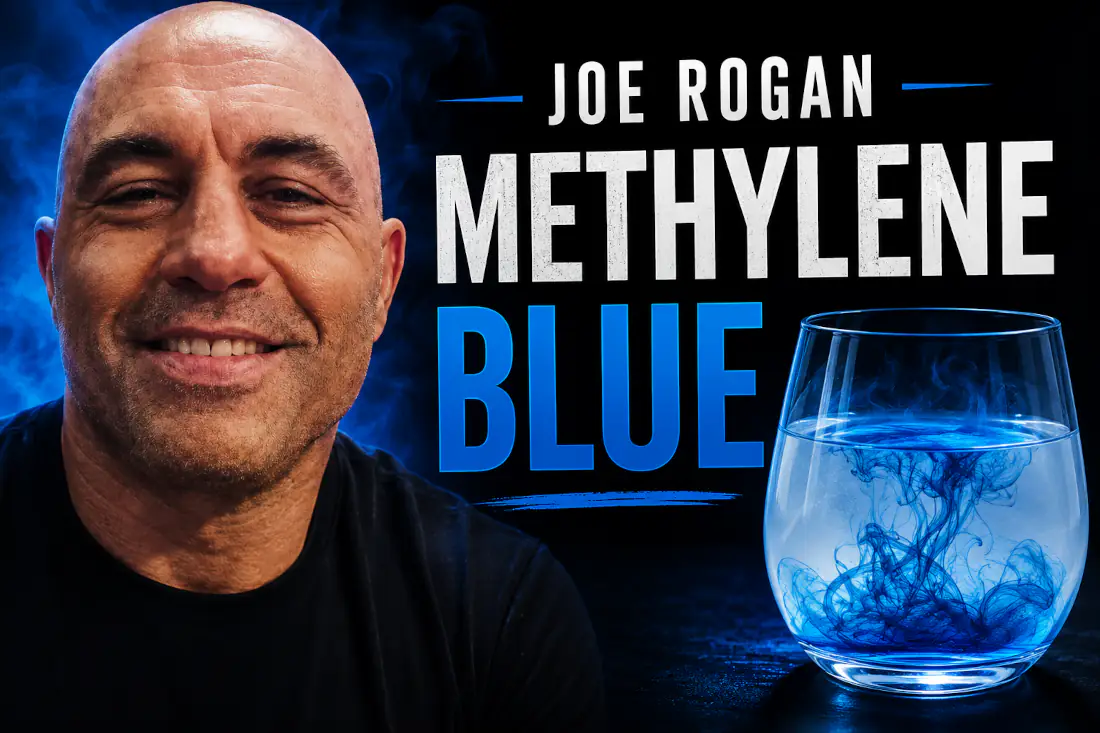
- Podcast Discussion: Joe Rogan has mentioned methylene blue on his podcast, including during a conversation with Mel Gibson where they discussed its potential effects on cellular energy and mitochondria.
- Personal Intake: Rogan has described taking methylene blue daily, using a dropper bottle to add it to some water, then drinking it.
- Product Options: Methylene blue is commonly available in capsule and liquid formats, with many liquid products offering a 1% solution designed for dropper-based dosing.
- Red Light Therapy Pairing: Rogan has also discussed combining methylene blue with red light therapy, an idea he said was suggested by Gary Brecka. The concept is that methylene blue may absorb red light, potentially increasing how cells respond during red light exposure.
Joe Rogan on Methylene Blue
Joe Rogan has spoken about methylene blue on his podcast, including in a conversation with Mel Gibson (source). The compound came up while they were discussing substances that may have effects on energy, cognition, and overall health.
In that exchange, Rogan pointed to methylene blue as one of those compounds that sounds unusual at first, especially given that it originally began as a textile dye. He also brought up the fact that it has been studied for its effects on mitochondrial function, which is one reason it continues to come up in biohacking and health discussions.
Another part of the conversation focused on the way certain compounds are treated when they fall outside mainstream medical narratives. Rogan suggested that when a substance later shows promise, it can lead people to question why it was dismissed so quickly in the first place.
You can listen to the full discussion here.
Dosage
Joe Rogan has mentioned taking methylene blue as part of his routine. In one discussion, he described adding liquid methylene blue from a dropper into a glass of water and drinking it. (Exact dosage hasn’t been specified).
See the next section for more info on dosage.

Rogan has also talked about methylene blue on his podcast with Chase Hughes, who described using it in a different form. Hughes explained that he takes methylene blue daily in troche form, typically around 40–80 milligrams per day. These troches are small chewable pieces, each containing about 40 mg, that can be cut into portions before swallowing.
According to Hughes, the troches need to be swallowed quickly because they can temporarily stain the teeth blue. During that conversation, Rogan noted that he also takes methylene blue daily, though his version involves adding a small drop to water rather than using troches.
Methylene Blue Dosage According to Research
Dose Range
Methylene blue follows a hormetic curve – low doses help, high doses harm. The research-backed low-dose window is 0.5–4 mg/kg, but most supplemental use stays at the lower end: 5–30 mg per day for general mitochondrial and cognitive support.
A placebo-controlled human trial from UT Austin1Multimodal Randomized Functional MR Imaging of the Effects of Methylene Blue in the Human Brain | Rodriguez et al. | 2016 | Radiology tested 280 mg (~4 mg/kg) in healthy adults and found improved attention and memory retrieval. Toxicity begins around 5–7 mg/kg, so there’s a wide margin at supplemental doses – but more is not better.
Using a 1% Dropper
Most liquid methylene blue is sold as a 1% solution = 10 mg/mL. If you’re targeting 10–20 mg per day, that’s 1–2 mL. Measure by volume using the dropper markings, not by counting drops, as dropper sizes vary. Some clinicians suggest starting at 5 mg/day and increasing by 5 mg monthly, with a day or two off per week.
Your urine (and possibly your tongue) will turn blue-green. That’s normal.
What We Don’t Know
The mitochondrial mechanism is well-characterized. Methylene Blue acts as an alternative electron carrier in the electron transport chain, boosting ATP production. But most human data comes from single-dose studies in small groups. Long-term daily protocols haven’t been validated in large trials. Methylene Blue also has MAOI properties and can interact dangerously with SSRIs and other serotonergic drugs. It’s contraindicated with G6PD deficiency and in pregnancy.

Methylene Blue Options
Joe Rogan has not publicly mentioned any specific methylene blue brands when discussing the compound. The options below are examples of methylene blue formulations.
Scroll right for full table →
| Product | Best For | Why It Fits |
|---|---|---|
| PureGood 1% Methylene Blue Liquid | Straightforward liquid methylene blue | 1% liquid solution providing about 10 mg per mL, third-party tested and packaged in an amber glass dropper bottle for measured dosing |
| Lunakai PRO Methylene Blue Capsules | Capsule-based methylene blue option | Capsule format with added vitamins C, B6, and B12; third-party tested formulation designed for convenient daily use |
| Better Life Lab - Liquid + Capsule Bundle | Flexible liquid + capsule combo | Combines fast-absorbing liquid tincture with convenient capsules; offers both rapid uptake and easy daily use in one bundle |
Methylene Blue With Red Light Therapy
Joe Rogan has also discussed methylene blue in the context of red light therapy during a podcast conversation with Chase Hughes. In that discussion, Rogan mentioned that Gary Brecka suggested combining methylene blue with red light therapy. [Gary Brecka has a lot more to say about Methylene Blue, our full guide covers everything he recommends about it.]
During the conversation, Chase appeared to suggest that MB enhances the effects of red-light therapy. The idea is based on methylene blue’s blue coloration, which allows it to interact with certain wavelengths of light. However, according to our research, whilst they both act on the mitochondria, they do so in different ways.
Methylene blue’s role in mitochondria:
- It acts as a redox cycler, meaning it can donate electrons within the mitochondrial electron transport chain.
- In practical terms, this allows methylene blue to ferry electrons through the early stages of the energy-production process inside the mitochondria.
Red-light therapy works through a different mechanism:
- Red and near-infrared light are absorbed by cytochrome c oxidase (complex IV) in the mitochondrial electron transport chain.
- This increases the activity of that enzyme and allows electrons to move through the later stages of the chain more efficiently.
Because of this, the two approaches are sometimes described as acting at different points in the mitochondrial energy pathway, which is why some commentators view them as complementary rather than methylene blue directly enhancing the effects of red-light therapy.
If you want to learn more about red light therapy, check out our guide on how Rhonda Patrick uses it for skin aging.
Red Light Therapy Options To Consider
Joe Rogan has mentioned using Joovv red light therapy devices. Beyond that, there are several red light therapy options available across different formats, depending on how you prefer to use them.
Scroll right for full table →
| Brand | Best For | Why It Fits |
|---|---|---|
| Joovv Go 2.0 | Portable, targeted therapy | Handheld device using red and near-infrared light for localized use and flexibility. |
| iRestore Professional Red Light Therapy Helmet | Hair-focused red light therapy | Uses laser and LED technology designed for scalp coverage and targeted hair support. |
| Ulike ReGlow LED Light Therapy Mask | Facial skin treatments | Multi-light LED mask designed for full-face coverage and targeted skincare use. |
You can listen to the full discussion here.
Final Thoughts
Joe Rogan has said that he takes methylene blue daily, typically adding a small drop into a glass of water. The compound has also come up in conversations with guests like Chase Hughes and Mel Gibson, both of whom spoke positively about it during discussions on the podcast.
Much of the attention around methylene blue comes from research examining its effects on mitochondrial function and cellular energy systems. While these mechanisms have been studied in laboratory and clinical settings, long-term human research on routine supplementation is still limited.
It’s also worth keeping the safety context in mind. Methylene blue has MAOI properties, which means it can interact dangerously with SSRIs and other serotonergic medications. It is also contraindicated for people with G6PD deficiency and during pregnancy, which is why medical guidance is important before considering its use.
If you’re curious about the wider range of supplements Rogan has discussed over the years, you can also explore our breakdown of Joe Rogan’s supplement routine.
Further Reading
If you found this useful, you may also enjoy:
- Gary Brecka Methylene Blue – A second expert’s take on the same compound, with more detail on dosing and the mitochondrial-efficiency case behind it.
- Gary Brecka NAD+ Protocol – Another compound aimed at cellular energy and mitochondrial function, and how one of its biggest advocates approaches it.
- Joe Rogan’s Peptide List – The peptides Rogan has talked about on the show, from the “Wolverine Stack” to his growth-hormone pairings.
- Joe Rogan’s Diet – His shift back to carnivore and what a typical day of eating looks like for him.
FAQs
Yes, Joe Rogan has mentioned that he takes methylene blue. On his podcast, he described adding methylene blue from a dropper bottle to his water, then drinking it. Noting that he takes it daily as part of his routine.
Methylene blue has a long history in medicine and has been used clinically to treat conditions such as methemoglobinemia. It has also been studied in research examining mitochondrial activity, cellular respiration, and neurological processes.
Methylene blue is historically a pharmaceutical compound used in medical treatments. Some modern products market it in supplement-style formats, though most research still focuses on clinical or laboratory contexts.
Some research suggests methylene blue may influence brain metabolism and memory-related processes. Because it can interact with mitochondrial energy pathways in neurons, the compound has attracted interest in discussions about cognitive performance, though research is still ongoing.
Methylene blue has been used medically for decades, but safety outside clinical settings can depend on factors such as dose, purity, and potential drug interactions.
Interest in methylene blue within biohacking communities comes from research on mitochondrial function and cellular energy. Because mitochondria play a key role in metabolism and brain activity, the compound has attracted attention in longevity and performance discussions.
Image Credits
- First image: “Joe Rogan” by Steven Crowder from Louder With Crowder, modified, licensed under CC BY 3.0
References
- 1Multimodal Randomized Functional MR Imaging of the Effects of Methylene Blue in the Human Brain | Rodriguez et al. | 2016 | Radiology ↩︎
Disclaimer: The above information is for research and educational purposes only and not a substitute for professional medical advice. See full medical disclaimer.
Note: We have no affiliation with Joe Rogan - this article is based on publicly shared information.