In this article we’ll look at the peptides Brecka points to, the dosing on the products he endorses, and his non-negotiable on sourcing.
Gary Brecka talks about peptides as amino acid sequences the body already recognises, not as drugs in the conventional sense. He maps specific peptides to specific goals: BPC-157 and TB-500 for injuries, CJC-1295 with Ipamorelin for growth hormone, GHK-Cu for skin and hair, and a handful of others for immunity and longevity.
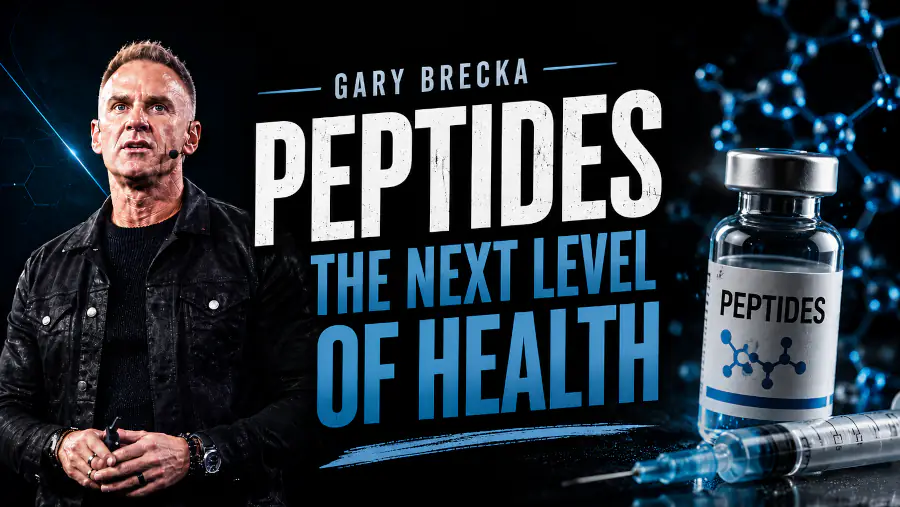
TLDR: Gary Brecka’s Peptide Protocol
- What peptides are: Short amino acid sequences, many of which act as signalling molecules.
- Injury and recovery: BPC-157 paired with TB-500 for joints, tendons, and gut issues.
- Growth hormone: CJC-1295 with Ipamorelin prompts the pituitary to produce more of its own GH, without replacing it.
- Sermorelin: A more established growth hormone releaser with an FDA history and an extensive clinical track record.
- Skin and hair: GHK-Cu triggers collagen production and may help with thinning hair.
- Immunity and longevity: Thymosin Alpha, Epitalon, Sermorelin, and Tesamorelin get a mention but no deep protocol.
- Peptide sourcing: Brecka suggests taking extra precautions before selecting a peptide provider to avoid purchasing low-quality products.
What Brecka Means by “Peptide”
Gary Brecka’s core framing is that peptides are not drugs. They are short sequences of amino acids that the body can recognize and process similarly to its own signaling molecules and metabolites (source).
The argument is that peptides encourage the body to carry out processes it already has pathways for – such as secreting growth hormone, regulating cortisol, or improving circulation – rather than introducing entirely foreign chemistry. Because they are amino acid sequences, the body can usually break them down and clear them efficiently.
He contrasts this with synthetics and pharmaceuticals, which he argues the body has no native pathway to eliminate. Whether or not that framing fully resolves the regulatory picture, it is the lens he uses for everything that follows.
Author’s Note: To push back slightly on Brecka’s framing – peptides work because they successfully bind to specific cell receptors, not because the body recognises them as endogenous metabolites.
Listen to the full episode here. This segment begins at ≈2:40.
According to Brecka, peptides can help enhance healing, performance, and long-term health, though they work best alongside essentials such as sleep, nutrition, and stress management. (source).
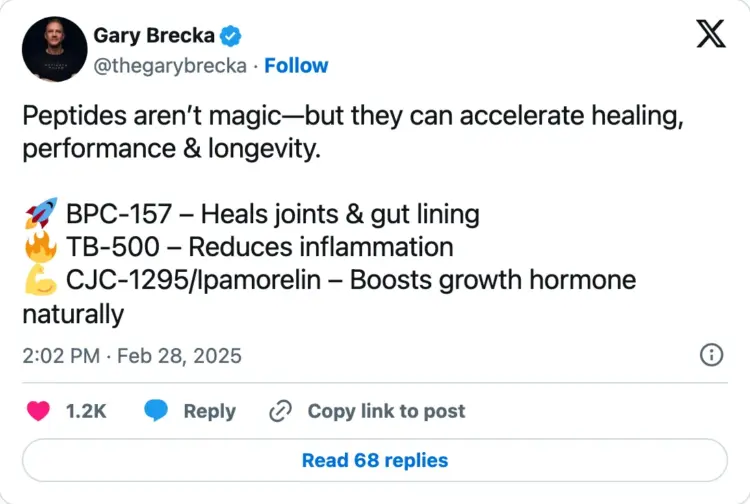
For Healing and Injury Recovery: BPC-157 + TB-500
This is the category he talks about most. The typical use case is with: knee, hip, shoulder, rotator cuff, and low back issues (source).
BPC-157
BPC-157 stands for Body Protection Compound 157. Brecka describes it as a gastric pentadecapeptide synthesised from gastric juice, a 15-amino-acid sequence that, when reintroduced into the body, calls platelets and growth factors to injury sites and helps accelerate tissue repair.
Watch the full clip here. This clip starts at ≈0:32.
What it may help with:
- Joint and soft-tissue recovery (knee, hip, shoulder, rotator cuff, low back).
- Gut issues, including leaky gut, inflammatory bowel, IBS, Crohn’s, and diverticulitis.
- Tendon and ligament healing, where platelet and growth-factor recruitment matters.
Brecka’s team have put thousands of patients on BPC-157 without a reported adverse event (source). Similarly, Brigham Buhler of Ways2Well claims to have put 75,000+ patients on peptides, across their practices, with no reported adverse events.
Listen to the full episode here. Jump to ≈10:10 for this segment.
Worth noting that this is a practice observation, not a controlled clinical trial. Mechanistically, a 2026 PubMed review points to angiogenesis, collagen synthesis, fibroblast activity, and nitric oxide modulation as the likely pathways.1From Regeneration to Analgesia: The Role of BPC-157 in Tissue Repair and Pain Management | Yuan et al. | 2026 | Int J Mol Sci
Author’s Note. Human trial data is limited to a handful of small pilot studies, and a 2025 University of Utah review concludes BPC-157 “should be considered investigational”.2Regeneration or Risk? A Narrative Review of BPC-157 for Musculoskeletal Healing | McGuire et al. | 2025 | Curr Rev Musculoskelet Med The FDA placed it on the Category 2 bulk drug list in 2023 and WADA banned it for athletes in 2022. It’s current “replacement” is pentadeca arginate (PDA), which is essentially the same molecule (same 15-amino-acid backbone), but isn’t scheduled. The difference between the two is that BPC-157 is typically formulated as an acetate salt, while PDA is formulated as an arginate (arginine) salt.
TB-500
TB-500 is associated with thymosin beta-4 activity and works on the same actin-binding pathway. Brecka pairs it with BPC-157 for injury recovery, in line with the Koniver-Huberman stacking pattern covered in our Huberman peptides article. Actin binding plays a role in cellular movement and tissue repair.3Utilizing Developmentally Essential Secreted Peptides Such as Thymosin Beta-4 to Remind the Adult Organs of Their Embryonic State—New Directions in Anti-Aging Regenerative Therapies | Maar et al. | 2021 | Cells
Brecka does not give a standalone injection dose for it.
The pairing is sold through Gary Brecka’s partner brand, Peptual, as a TB-500 and BPC-157 nasal spray. If you want this pairing in an injectable form, Live Vital provides it through a licensed pharmacy.
For Growth Hormone: CJC-1295 + Ipamorelin
His go-to growth hormone pairing is CJC-1295 with Ipamorelin. These are growth hormone releasers, peptides that prompt the pituitary to secrete more of the body’s own GH. They are not exogenous HGH, which he treats as a different intervention with a different risk profile.
The product he suggests through The Ultimate Human is a CJC-1295 7.5 mg + Ipamorelin 15 mg injectable blend via Peptual. It is a telehealth-gated product (source).
Catch the full episode here. Jump to ≈16:00 for this segment.
He frames CJC-1295 as a growth hormone releaser to stack with Ipamorelin, with the appeal being a boost to performance without “shutting down your own” (source).
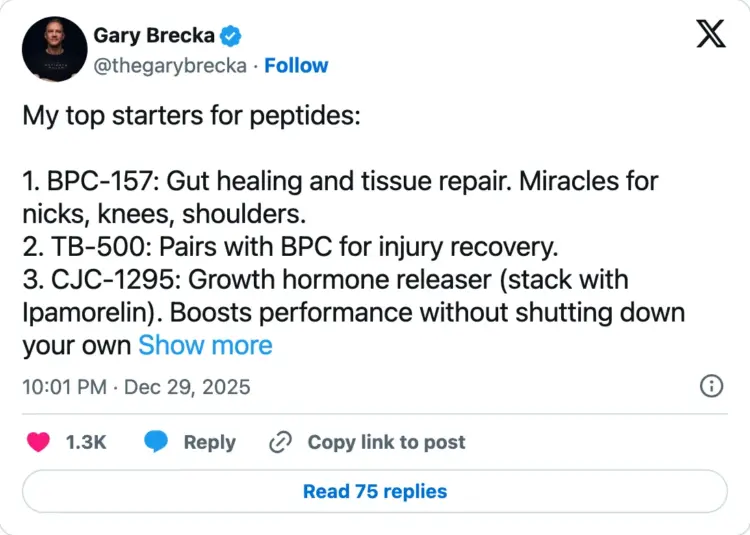
While the product Brecka points to runs through Peptual, the same CJC-1295 and Ipamorelin combination is also available via other telehealth providers like Live Vital.
Sermorelin
Sermorelin is a growth hormone releaser Brecka groups alongside CJC-1295 and Ipamorelin when mapping peptides to goals (source). It works by prompting the pituitary to secrete more of the body’s own growth hormone rather than introducing exogenous HGH directly.
What sets it apart from Ipamorelin:
- Sermorelin was FDA-approved under the brand name Geref — first as a diagnostic agent in 1990, then for GH deficiency in children in 1997 (Federal Register, PubMed).
- Ipamorelin never completed the trials required for human approval and has no established dosing structure.
- This makes Sermorelin the more established starting point for those comparing GH releasers.
How it works in practice:
- Half-life is around 10 to 20 minutes4Pharmacokinetics of growth hormone-releasing hormone(1-29)-NH2 and stimulation of growth hormone secretion in healthy subjects after intravenous or intranasal administration | Wilton et al. | 1993 | Acta Paediatr Suppl, so it produces a brief GH pulse after each injection rather than sustained elevation.
- Typically dosed daily at night to align with the body’s natural nocturnal GH release.
What it may help with:
- Increasing the body’s natural growth hormone output.
- Supporting muscle recovery and body composition over time.
- Sleep quality, as GH secretion is closely tied to slow-wave sleep.
Author’s Note. The direct mechanism – stimulating GH release – is well established. The downstream benefits like muscle recovery, body composition, and sleep improvement are less robustly proven in healthy adults. Most clinical evidence comes from treating GH deficiency in children or age-related GH decline in older adults; trials in healthy adults are small and limited in scope.
Because Sermorelin was previously FDA-approved, compounding pharmacies have a clear legal pathway to produce it per prescription. That’s what makes it readily available via telehealth provider like Hone Health and AgelessRx, whereas peptides like Ipamorelin – which were never FDA-approved – lack that pathway and face greater regulatory restrictions.
For Skin, Hair, and Collagen: GHK-Cu
GHK-Cu is a copper-binding tripeptide Brecka points to for skin elasticity, collagen repair, and thinning hair. He frames it as triggering collagen production, repairing tissue, and helping regrow thinning hair (source).
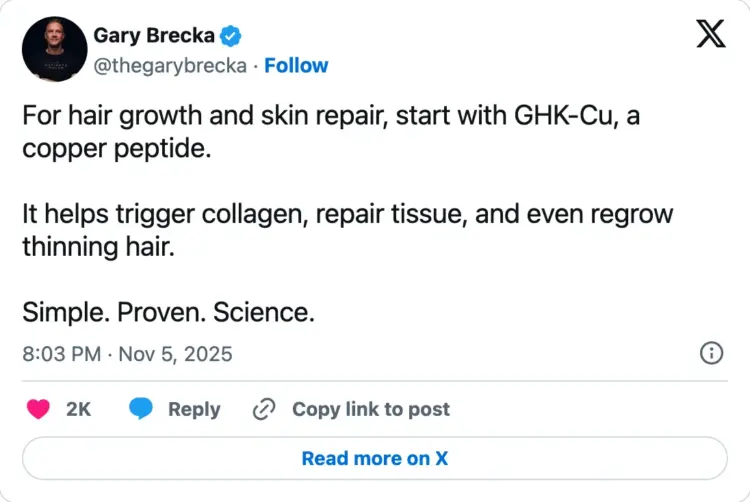
It is also one of the three actives in the Peptual transdermal patch he endorses, alongside BPC-157 and NAD+:
- BPC-157: ~2000 mcg
- NAD+: ~250 mg
- GHK-Cu: ~10 mg
The patch combines tissue repair (BPC-157), cellular energy (NAD+), and collagen synthesis (GHK-Cu) in a sustained-release format (source). Preclinical work on GHK-Cu supports a role in collagen synthesis and tissue repair, though human trial data is limited.
If you’d rather not source raw GHK-Cu, Live Vital offers it in an injectable form through a licensed pharmacy, and Hone Health does the same for NAD+.
Other Peptides Brecka Mentions
Brecka maps several more peptides to categories without going deep on any of them (source):
- Thymosin Alpha – for immune modulation.
- Epitalon – a telomerase-related peptide, framed as longevity-leaning.
- Tesamorelin – similar pathway to sermorelin, with a specific association with visceral fat reduction. (If you want to try it, Live Vital offers Tesamorelin as a prescribed protocol through a licensed pharmacy.)
He does not give standalone protocols for these.
How Brecka Points to Sourcing Peptides Safely
His sourcing rule is non-negotiable. He is blunt about online vendors: lots of these come from China, are “fraught with heavy metals,” and some have been tested to contain no actual peptide at all (source). His rule of thumb:
- Avoid “research use only” labelled product bought through unverified online sellers.
Watch the full episode here. This segment starts at ≈14:55.
Beyond his own Peptual products, readers can ask a prescribing physician about reputable compounding pharmacies in their region, or a telehealth peptide clinic if no local provider has peptide experience. UK readers face a different regulatory picture entirely, which we cover in Are peptides legal in the UK?.
One regulatory note worth holding alongside his framing: the FDA placed several of the peptides he discusses (including BPC-157, CJC-1295, and Ipamorelin) onto a Category 2 list in 2023, citing a lack of safety data rather than reported harms. The regulatory picture around compounding continues to evolve, so it’s worth checking current status with a prescribing physician.
Sourcing safely is one half of it. Knowing what you are treating is the other, and it is the half Brecka talks about most. He built his whole profile on reading people’s blood work before recommending anything, so the consistent move is to have a credible provider such as Hone Health read your own markers first, and let those decide whether a peptide protocol is the right intervention at all.
Roundup
Brecka’s peptide framework is goal-based and tightly opinionated: BPC-157 plus TB-500 for healing, CJC-1295 plus Ipamorelin for growth hormone, GHK-Cu for skin and hair, and a longer tail of immune and longevity peptides he mentions but rarely elaborates on. Across all of it, he keeps returning to one frame: peptides are amino acid sequences the body recognises, not drugs in the conventional sense. Sourcing is where he refuses to budge, physician prescription and a reputable tele-health platform, never an online vendor selling under a “research use only” label.
For a broader look at what he takes day to day, see the Gary Brecka supplement list.
Further Reading
If you found this post on Gary Brecka’s peptides helpful, you may also like:
- Bryan Johnson’s Peptide List – The peptides the longevity-obsessed entrepreneur has tested, tracked, and in some cases dropped, with his data-driven reasoning for each.
- Joe Rogan’s Peptide List – From the “Wolverine Stack” of BPC-157 and TB-500 to his growth-hormone pairings, a look at what the Joe Rogan has used and how he’s talked about the recovery results.
- Joe Rogan’s Supplement List – A performance-focused stack with context on the broader biohacking-podcast supplement world.
- Gary Brecka’s NAD+ Protocol – The form of NAD+ Brecka prefers and why he treats it as a cornerstone of his cellular-energy and longevity approach.
If you’ve got questions or comments on Brecka’s peptide framework, please leave them below.
Thumbnail: Gary Brecka by Gage Skidmore, CC BY-SA 2.0
FAQs
Brecka points to BPC-157 paired with TB-500 as his starter combination for knee, hip, shoulder, rotator cuff, and low back issues. He frames BPC-157 as calling platelets and growth factors to injury sites, and TB-500 as supporting cellular movement and tissue repair. Both should be physician-prescribed.
BPC-157 is Body Protection Compound 157, a 15-amino-acid sequence Brecka describes as synthesised from gastric juice. He talks about it because his clinical team has used it widely for joint, tendon, and gut issues, with no reported adverse events in their patient base.
Growth hormone peptides such as CJC-1295, Ipamorelin, Sermorelin, and Tesamorelin prompt the pituitary to release more of the body’s own growth hormone. Exogenous HGH, by contrast, is the hormone itself, injected directly. Brecka favours the secretagogue route on the grounds that it is less likely to shut down endogenous production.
He points to physician-guided prescription through telehealth peptide clinics as the sourcing route he is willing to endorse. He warns that many online peptide vendors source from overseas suppliers, with risks of contamination, mislabeling, or products that contain no peptide at all.
The regulatory picture varies and continues to evolve. In the US, several of these peptides sit on the FDA’s Category 2 bulk-substance list as of this writing, and WADA banned BPC-157 for athletes in 2022. Current compounding status is worth checking with a prescribing physician. UK readers should see our peptide legality article for the local picture.
References
- 1From Regeneration to Analgesia: The Role of BPC-157 in Tissue Repair and Pain Management | Yuan et al. | 2026 | Int J Mol Sci ↩︎
- 2Regeneration or Risk? A Narrative Review of BPC-157 for Musculoskeletal Healing | McGuire et al. | 2025 | Curr Rev Musculoskelet Med ↩︎
- 3
- 4Pharmacokinetics of growth hormone-releasing hormone(1-29)-NH2 and stimulation of growth hormone secretion in healthy subjects after intravenous or intranasal administration | Wilton et al. | 1993 | Acta Paediatr Suppl ↩︎
Disclaimer: The above information is for research and educational purposes only and not a substitute for professional medical advice. See full medical disclaimer.
Note: We have no affiliation with Gary Brecka - this article is based on publicly shared information.


.jpg)