This article explores Gary Brecka’s approach to magnesium, covering the specific forms he talks about, when he suggests taking it, and how it’s used to support areas like sleep, digestion, and overall health.
TLDR: Gary Brecka Magnesium Routine
- 7-form nightly blend: Gary Brecka personally uses a multi-form magnesium supplement before bed, often paired with L-theanine as part of his nighttime routine.
- Different forms target different uses: He links glycinate with relaxation, L-threonate with cognitive support, citrate with digestion, and malate with energy and recovery.
- 400 mg is close to NIH intake guidance: His commonly mentioned 400 mg daily amount matches the NIH RDA for adult men, while higher supplemental intake may increase the likelihood of digestive side effects.
- The deficiency statistic is disputed: Brecka often cites a 75% magnesium deficiency rate, while NIH-backed NHANES data reports that roughly 48% of Americans consume less magnesium than recommended.
- Sleep studies show limited but measurable effects: Recent randomized trials found magnesium may improve certain sleep metrics in poor sleepers, though current evidence does not show it as a standalone solution for insomnia.
- Magnesium is part of a wider sleep system: Brecka pairs magnesium with habits like reducing caffeine, limiting screens, breath work, and maintaining a dark, cool sleep environment.
Magnesium Brand

Gary Brecka takes BiOptimizers Magnesium Breakthrough, a blend with 7 forms of magnesium, before bed.
He’s said this on Joe Rogan (JRE #2304), in a Top Supplements clip, and in his own X post tagging BiOptimizers.
In his words from the Top Supplements clip:
“I take a supplement that has all seven forms of magnesium at night before bed.”
On The Ultimate Human podcast #036 he notes pairing magnesium with theanine as part of his sleep routine.
Brecka’s personal stack: BiOptimizers Magnesium Breakthrough, taken before bed, alongside L-theanine.
What he takes is a 7-form blend – covering all the goals at once. What he suggests for other people is different, and goal-dependent.
If capsules aren’t your thing, BiOptimizers also makes a Magnesium Breakthrough Drink, a powdered mix-with-water version with 8 forms of magnesium plus added electrolytes, in flavors like Banana Mango, Cherry, and Raspberry Lemonade.
Brecka doesn’t mention this one. His own stack is the capsules. But if you’d rather sip your magnesium than swallow pills, or you want the electrolyte support alongside it, the drink covers similar ground from the same brand.
Types of Magnesium
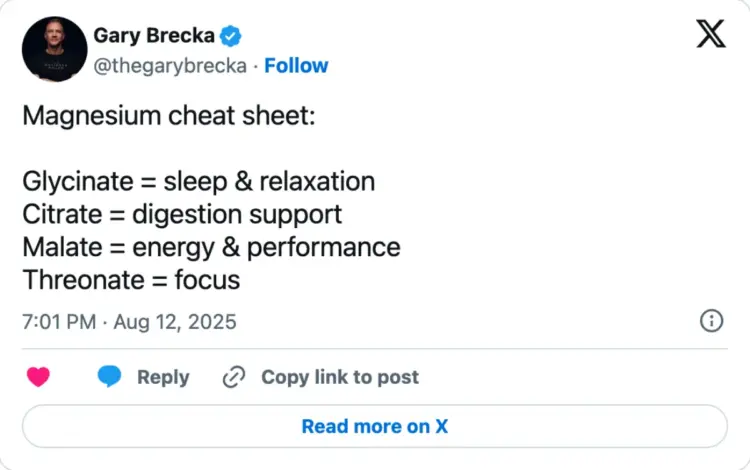
Across his X posts and podcast appearances, Brecka points to different forms of magnesium for different purposes. He’s repeated this “magnesium cheat sheet” several times – most recently in this X post.
His mapping:
- Glycinate – for sleep and relaxation. Magnesium glycinate is magnesium bound to the amino acid glycine. Here are some popular options:
- Pure Encapsulations Magnesium Glycinate – a go-to in the functional medicine world
- Metagenics Magnesium Glycinate – practitioner-grade formulation
- Solaray Magnesium Glycinate – gentle, well-absorbed magnesium for sleep and relaxation
- L-threonate – for focus, brain fog and anxiety. A form associated with research into elevating brain magnesium levels. Some well-regarded brands include:
- Momentous Magtein (see 20% off coupon) – suggested by Andrew Huberman
- Life Extension Neuro-Mag Magtein – well-dosed and widely available
- Citrate – for digestion and constipation. Magnesium citrate has a known laxative effect at higher doses. A few popular choices:
- Metagenics Magnesium Citrate – highly absorbable magnesium for digestion and muscle support
- Nutricost Magnesium Citrate – great value
- Malate – for energy and recovery. Magnesium malate combines magnesium with malic acid. Some options worth considering:
- Momentous Magnesium Malate (see 20% off coupon)
– magnesium for energy production and muscle recovery - Nutricost Magnesium Malate – excellent budget pick
- Momentous Magnesium Malate (see 20% off coupon)
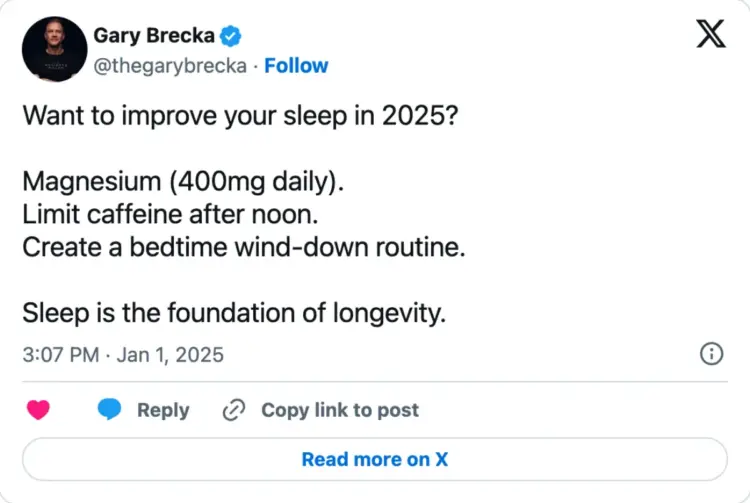
In his sleep-hygiene post Brecka suggests taking magnesium glycinate around 1 hour before bed. On The Ultimate Human #036 he names magnesium L-threonate as one of his go-to sleep forms, often paired with theanine.
For a default daily dose for sleep, in this X post he suggests 400 mg per day.
NIH Guidance
The NIH Office of Dietary Supplements factsheet sets the Recommended Daily Allowance (RDA) for magnesium as:
- Men 19-30: 400 mg per day
- Men 31+: 420 mg per day
- Women 19-30: 310 mg per day
- Women 31+: 320 mg per day
Brecka’s 400 mg suggestion sits at the RDA for adult men, and somewhat above the RDA for adult women.
The same factsheet sets a Tolerable Upper Intake Level (UL) of 350 mg per day for supplemental magnesium in adults. The UL applies to magnesium from supplements only, not from food. Per the NIH, going above it isn’t a hard ceiling, but it’s the threshold above which gastrointestinal side effects (diarrhea, nausea, cramping) become more likely.
The “75% Deficient” Claim
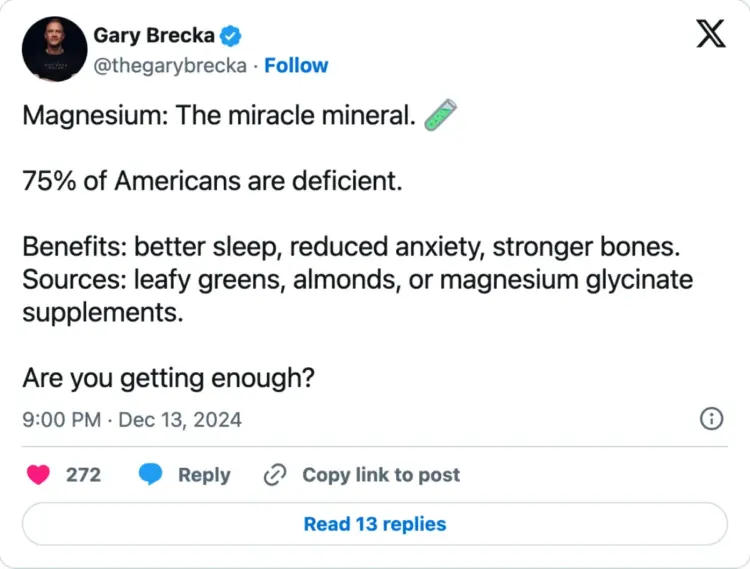
Brecka has stated publicly that around 75% of Americans are magnesium deficient. It’s a striking number, and he uses it to justify supplementation.
The most rigorous figure available is from the NIH ODS factsheet:
48% of Americans of all ages get less magnesium from food and beverages than their respective Estimated Average Requirement (EAR).
The two numbers measure different things. Intake inadequacy (what NHANES measured) is not the same as biochemical deficiency (low serum or red-blood-cell magnesium). A person can have inadequate intake without being clinically deficient, and vice versa.
In essence: the NIH-grounded figure for intake inadequacy is 48%, not 75%. Brecka’s framing leans harder than the data supports. The underlying point – that a meaningful share of the population isn’t getting enough – is consistent with NIH data.
For reference, magnesium is involved in over 300 enzymatic reactions in the human body, per the NIH factsheet.
RCT Evidence for Sleep

Brecka frames magnesium as a sleep aid. Two recent randomized controlled trials are worth knowing about.
A 21-day RCT in 80 adults aged 35-55 with self-reported sleep problems. Participants took 1 g per day of magnesium L-threonate (containing roughly 75 mg of elemental magnesium). Sleep was measured by Oura Ring.1Magnesium-L-threonate improves sleep quality and daytime functioning in adults with self-reported sleep problems: A randomized controlled trial | Hausenblas et al. | 2024 | Sleep Med X
Compared to placebo, the L-threonate group showed:
- Significant improvement in deep sleep score (p<0.001)
- Significant improvement in REM sleep score (p=0.020)
- Significant improvement in light sleep time (p=0.006)
A 4-week trial in 155 adults with poor sleep, using 250 mg per day of elemental magnesium as bisglycinate.2Magnesium Bisglycinate Supplementation in Healthy Adults Reporting Poor Sleep: A Randomized, Placebo-Controlled Trial | Schuster et al. | 2025 | Nat Sci Sleep
The Insomnia Severity Index (ISI) dropped 3.9 points in the magnesium group vs 2.3 in placebo (p=0.049). The effect size was small (Cohen’s d=0.2). Most secondary sleep-quality outcomes did not show a significant between-group difference.
In essence: the RCT evidence supports a modest sleep benefit from magnesium, particularly in poor sleepers. It does not support a claim that magnesium “fixes” insomnia.
Brecka’s Sleep Routine – Magnesium in Context
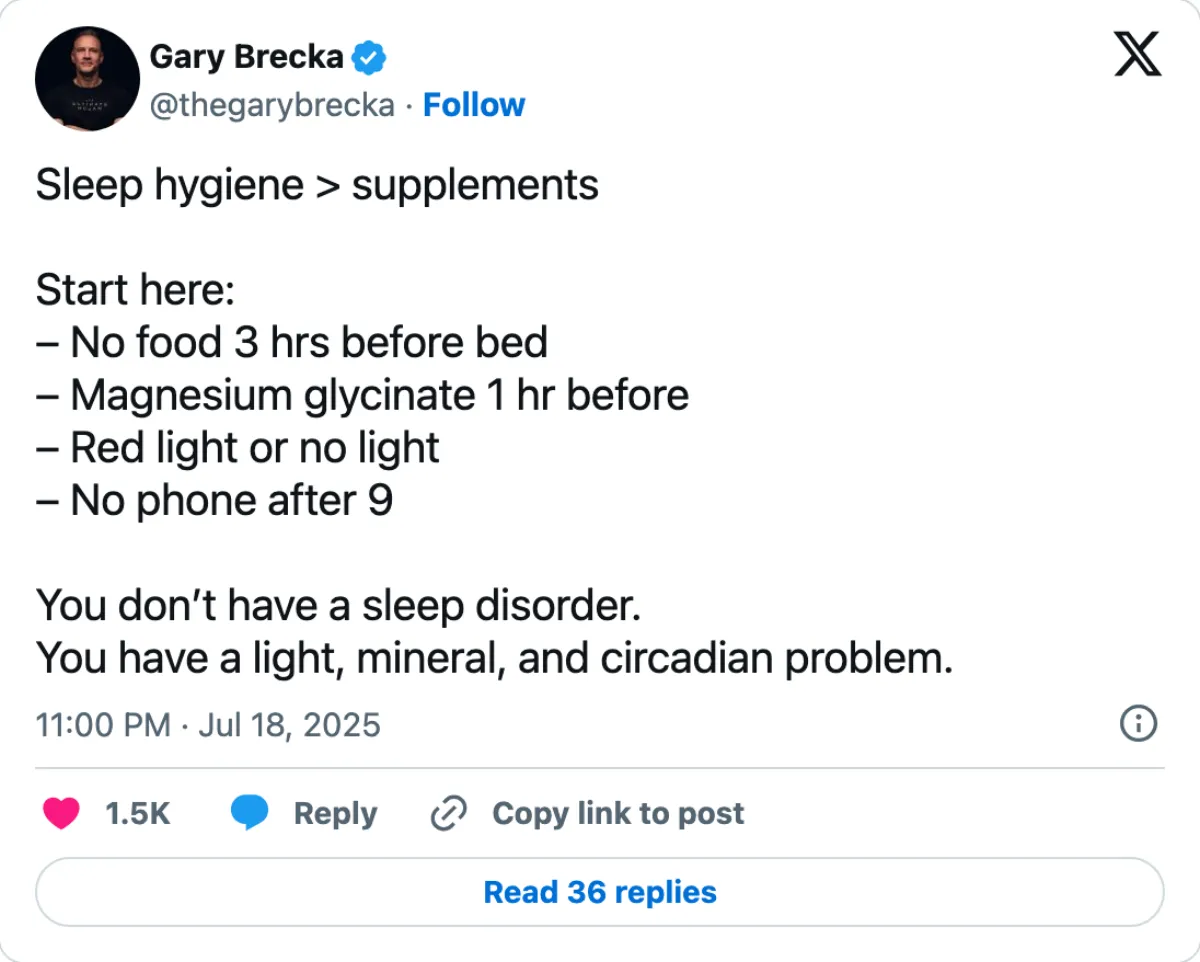
Brecka has been clear that magnesium is one piece of his sleep protocol, not a fix on its own. The protocol includes:
- The 10-3-2-1-0 rule – 10 hours before bed, no caffeine; 3 hours before, no food or alcohol; 2 hours before, no work; 1 hour before, no screens; 0 snoozes in the morning.
- Magnesium, taken before bed.
- Box breathing to wind down.
- A dark, cool room.
On The Ultimate Human #036 Brecka frames the whole routine with his own hedge:
“This is not medical advice it’s not meant to replace a consultation with a board certified or a licensed practitioner this is just what i do to go to sleep.”
He’s reporting a routine, not prescribing one.
Magnesium vs. Sleep Medications
Gary Brecka contrasts magnesium with traditional sleep medications by focusing on how the body responds to each approach. Rather than relying on sedatives, he emphasizes using compounds that the body naturally recognizes.
He notes that he is not a fan of using tranquilizing medications to induce sleep, and instead prefers supporting the body’s natural sleep cycles through metabolites. In this context, magnesium is positioned as a foundational option.
He also expresses caution around common sleep aids like melatonin, suggesting that while it can be used, it should be taken in lower doses. Magnesium, on the other hand, is something he consistently prefers as part of a nighttime routine.
- Prefers magnesium as a natural sleep-support compound
- Suggests combining it with practices like breath work before bed
- Mentions other compounds like theanine and low-dose melatonin in certain cases
In contrast to prescription sleep medications such as zolpidem, diazepam, and Xanax, magnesium is presented as a way to support sleep without relying on sedation. Gary Brecka’s magnesium supplementation approach focuses on working with the body’s existing systems rather than overriding them.
Roundup
Gary Brecka approaches magnesium as a foundational supplement that supports multiple systems in the body, rather than focusing on a single outcome. His emphasis is on consistent nightly use, selecting the right form based on the goal, and using magnesium as part of a broader routine centered on sleep and recovery.
He positions magnesium as a practical tool for improving sleep quality, supporting digestion, and addressing widespread deficiency linked to modern food quality. Instead of relying on sedative-based sleep aids, his approach focuses on using compounds the body recognizes to support natural processes.
Magnesium is just one piece of the picture, and it sits alongside everything else in his full supplement list, where you can see how these foundational nutrients work together.
Further Reading
If you want to go deeper into Gary Brecka’s supplementation approach, these articles expand on related areas:
- Gary Brecka Methylated Multivitamin – Why he leans on bioactive, methylated forms of nutrients and what that means for absorption and core biochemical function.
- Gary Brecka Methylene Blue – His take on mitochondrial support and the reasoning behind adding such an unconventional compound.
- Gary Brecka Creatine – How he frames creatine beyond the gym, spanning strength, recovery, and cognitive performance.
- Gary Brecka NAD+ Protocol – The form of NAD+ he reaches for, his dosing logic, and why he treats it as central to healthy aging and repair.
- Eric Berg Magnesium – A different expert’s perspective on magnesium, covering the forms he recommends and how his take compares to Brecka’s for sleep, stress, and deficiency.
If you’ve any questions or comments, please leave them below.
FAQs
Gary Brecka describes magnesium as a commonly deficient mineral and suggests using it regularly, particularly at night, to support sleep, digestion, and overall function.
Gary Brecka suggests taking magnesium before bed as part of a nightly routine, especially for individuals dealing with sleep issues or racing thoughts.
Gary Brecka discusses different forms of magnesium depending on the goal, including magnesium threonate, glycinate, and citrate.
Yes, Gary Brecka suggests magnesium as a sleep-support compound, particularly for people who experience mental overactivity at night.
Gary Brecka is not a fan of using tranquilizing sleep medications and instead prefers compounds like magnesium that support the body’s natural sleep cycles.
Thumbnail: Gary Brecka by Gage Skidmore via Wikimedia Commons (CC BY-SA 2.0).
References
- 1Magnesium-L-threonate improves sleep quality and daytime functioning in adults with self-reported sleep problems: A randomized controlled trial | Hausenblas et al. | 2024 | Sleep Med X ↩︎
- 2Magnesium Bisglycinate Supplementation in Healthy Adults Reporting Poor Sleep: A Randomized, Placebo-Controlled Trial | Schuster et al. | 2025 | Nat Sci Sleep ↩︎
Disclaimer: The above information is for research and educational purposes only and not a substitute for professional medical advice. See full medical disclaimer.
Note: We have no affiliation with Gary Brecka - this article is based on publicly shared information.



.jpg)