This article breaks down Gary Brecka’s creatine protocol, including how he talks about using it, the dosing approach he follows, and how it fits into his broader performance and supplementation strategy.
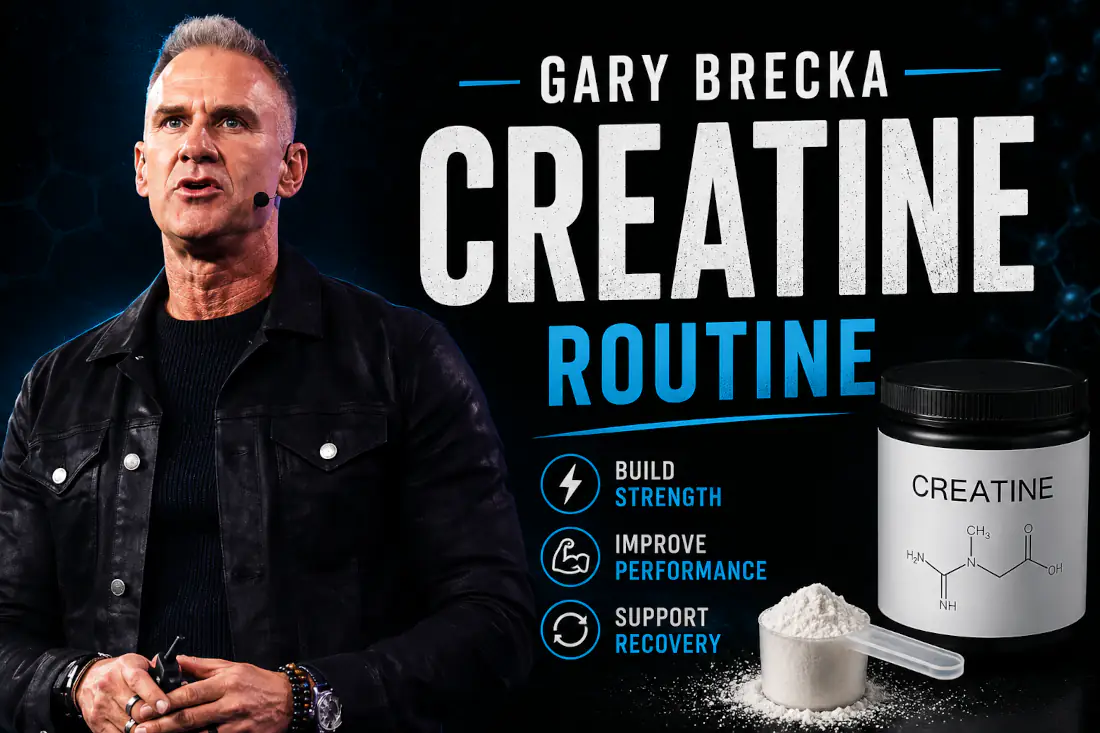
TLDR: Gary Brecka Creatine Supplementation Strategy
- Daily Intake: Typically around 5 grams per day, often taken before exercise, with higher amounts mentioned depending on individual needs.
- Preferred Format: Favors liquid and liposomal creatine for convenience and ease of absorption, with options like Cymbiotika and Rho Nutrition referenced.
- Type Selection: Shows a preference for creatine HCl due to digestion and comfort, although other forms like monohydrate are common.
- Women’s Use: Prefers consistent intake for women over 40, generally in the 5 to 7 gram range, with higher amounts discussed for cognitive support.
- Key Benefits: Covers muscle growth, recovery, joint support, and cognitive function, with creatine positioned as more than just a performance supplement.
- Cognitive Research: References early-stage research in Alzheimer’s patients showing improvements in cognitive markers over a short duration.
Dosage + Timing
Gary Brecka presents creatine as a daily supplement rather than something used occasionally.
His approach is straightforward:
- Around 5 grams per day as a baseline intake
- Taken prior to exercise as part of a regular routine
- Intake can go up to 20 grams per day, which he has mentioned in contexts like higher performance demands or cognitive support.
The key idea in his approach is consistency, with timing centered around training rather than cycling creatine on and off.
Author’s note: The dosage mentioned in the audio appears to be misstated as milligrams (mg); based on standard usage, grams (g) were likely intended.
You can explore the full conversation here – this section begins at ≈52:50
Brand
Gary Brecka has mentioned that he prefers using creatine in a liquid form, mainly for convenience and ease of use rather than any specific performance-related reason.
He also explains why he leans toward liposomal versions. According to his description, liposomal delivery involves surrounding compounds with small fat particles, which helps them pass through the digestive system more effectively. This allows the creatine to avoid being broken down by stomach acid or digestive enzymes and reach the intestines where it becomes more available for absorption.

This is why he tends to prefer liquid and liposomal creatine products, and he has referenced using options from brands like Cymbiotika(see 20% off iHerb coupon) and Rho Nutrition.
Listen to the full episode here. This segment begins at ≈6:45
He specifically describes using small, pre-measured packs from Rho Nutrition:
- Around 1500 mg of creatine per pack
- Easy to take without mixing
- Designed for on-the-go use
Beyond the format, his main consideration is product quality. He emphasizes choosing creatine that is not loaded with unnecessary additives or byproducts, keeping the formulation as simple as possible.
The overall takeaway from his approach is prioritizing convenience, absorption, and consistency, making it easier to take creatine daily without adding complexity to the routine.

You can check out the full discussion here.
Author’s Note: Brecka’s absorption rationale overstates the problem. Research1Bioavailability, Efficacy, Safety, and Regulatory Status of Creatine and Related Compounds: A Critical Review | Kreider et al. | 2022 | Nutrients shows creatine monohydrate is not meaningfully degraded during digestion and reaches approximately 99% intestinal absorption. Whilst 99% is absorbed in the gut – once the muscles reach saturation, the rest is excreted via the urine. Given that creatine monohydrate already achieves near-complete intestinal absorption, there is no robust clinical evidence that liposomal delivery produces meaningfully greater muscle creatine loading.
Creatine can also be consumed in capsules and powder form. Common examples of creatine brands that offer powders and capsules include:
Capsules - Creatine Monohydrate
| Brands | Quantity | Price per gram |
|---|---|---|
| Nutricost | 500 x 750 mg capsules | $0.07 |
| California Gold Nutrition | 240 x 750 mg capsules | $0.10 |
Powders - Creatine Monohydrate
| Brands | Quantity | Price per gram |
|---|---|---|
| Nutricost | 500 g | $0.04 |
| NOW | 500 g | $0.06 |
| Momentous Creatine | 450 g | $0.09 |
Creatine Forms
Gary Brecka has expressed a clear preference for creatine hydrochloride (HCl) over other forms.
He highlights two common forms:
- Creatine monohydrate
- Creatine hydrochloride (HCl)
According to him, creatine monohydrate can cause bloating for some individuals, which is why he leans toward creatine HCl. He describes himself as a strong supporter of creatine hydrochloride and prefers it over other forms.
From his perspective, the choice comes down to how the body responds, particularly in terms of digestion and comfort.
Author’s Note: While creatine HCl is often promoted for improved absorption or reduced side effects, current research2Common questions and misconceptions about creatine supplementation: what does the scientific evidence really show? | Antonio et al. | 2022 | Journal of the International Society of Sports Nutrition has not consistently shown it to outperform creatine monohydrate. Most evidence still supports monohydrate as the most studied and reliable form in terms of effectiveness.

The entire episode is available here — this part starts at ≈52:32
Creatine & Women
Gary Brecka places particular emphasis on creatine intake for women3Creatine Supplementation in Women’s Health: A Lifespan Perspective | Smith-Ryan et al. | 2021 | Nutrients over 40, highlighting its role beyond just physical performance.
He suggests that creatine can support areas like cognitive function, focus, and overall hormonal balance. In his view, it is not just a gym supplement but something that plays a broader role in how the body and brain function.
Based on his suggestions, he advises:
- A minimum of around 5 grams per day for women over 40
- Typically in the range of 5 to 7 grams daily
- In cases of brain fog or issues with focus and concentration, intake can go up to around 20 grams per day
He presents this as a consistent part of a routine rather than something used occasionally, often emphasizing it across his female clients in this age group.
If you want to explore how other female-focused protocols approach creatine, you can also check out our breakdowns of Stacy Sims Creatine and Rhonda Patrick Creatine.

Author’s Note: The claim that creatine supports “hormonal balance” overstates the research. As per research4Creatine Supplementation in Women’s Health: A Lifespan Perspective | Smith-Ryan et al. | 2021 | Nutrients, the relationship runs in the opposite direction: estrogen and progesterone influence creatine metabolism, not creatine regulating hormones.
Author’s note: The measurement provided in the audio is in milligrams (mg); this appears inconsistent with typical usage, where grams (g) are standard.
Listen to the full podcast here.
Benefits of Taking Creatine
Gary Brecka describes creatine as one of the more well-rounded supplements, with benefits that go beyond just muscle building.
Physical Performance & Muscle
Brecka highlights creatine’s role in improving muscle output and overall body composition, especially for those who train consistently. He points out that creatine helps the muscle retain water, which contributes to both performance and appearance.
- Commonly used alongside regular resistance or high-intensity training
- Often taken daily rather than only on workout days
- Typically paired with consistent protein intake and overall training routine

Recovery & Structural Support
He also extends creatine’s benefits beyond muscle, emphasizing its role in supporting tissues that are often slower to recover. In his view, areas like ligaments and tendons are typically underserved compared to muscle tissue.
- Often discussed in the context of joint discomfort during training
- Used as part of routines focused on long-term structural support
- Included in protocols aimed at maintaining performance over time
Author’s Note: The evidence for creatine directly supporting ligaments and tendons is limited. Clinical trials have found no significant benefit on strength recovery following ACL reconstruction, and the broader role of creatine in tendon structure and healing has not yet been established in the research.5The Application of Creatine Supplementation in Medical Rehabilitation | Harmon et al. | 2021 | Nutrients
Cognitive & Brain Function
Brecka places strong emphasis on creatine’s neurological benefits, noting that it can cross the blood-brain barrier and influence brain function. He connects this to improvements in memory, focus, and overall mental performance.
- Used in contexts related to focus, concentration, and mental clarity
- Often highlighted for individuals experiencing brain fog
- Discussed more frequently in relation to aging and cognitive support
From his perspective, creatine is not limited to physical performance but plays a broader role across both body and brain function.

First Alzheimer’s Creatine Trial
In a discussion on his podcast with Max Lugavere, Gary Brecka referenced a small pilot study6Creatine monohydrate pilot in Alzheimer’s: Feasibility, brain creatine, and cognition | Smith et al. | 2025 | Alzheimers Dement (N Y) looking at creatine use in individuals with Alzheimer’s disease. The study was brought up as part of a broader conversation around creatine’s potential role in brain function.
The study design was relatively simple:
- Around 20 participants with Alzheimer’s
- No placebo group (single-arm trial)
- Duration of approximately 8 weeks
- Daily intake of around 20 grams of creatine
According to the discussion, the results showed improvements across multiple cognitive assessments over the course of the study. While the sample size was small and the study lacked a control group, both Brecka and Lugavere pointed to the outcomes as notable given the short duration and the population involved.
They also framed it in the context of creatine’s ability to support brain energy systems, which is why it is being explored in neurological conditions. The conversation highlighted that this type of research is still in early stages, but it reflects a growing interest in looking beyond creatine’s traditional use in physical performance.
Rather than presenting it as a definitive treatment, Brecka referenced the study as an example of how creatine is being investigated in new areas, particularly those related to cognitive health and aging.
Roundup
Gary Brecka presents creatine as more than just a performance supplement, framing it as a compound that supports both physical output and cognitive function. In his approach, the focus is on consistent daily use, simple dosing, and choosing formats that improve convenience and absorption, such as liquid or liposomal versions.
Rather than limiting creatine to strength training, he discusses its role across muscle, recovery, and brain function, including its potential relevance with aging and cognitive health. His perspective positions creatine as a foundational supplement that fits into a broader strategy centered on energy systems and overall function.
It’s one of several staples he relies on, and his full supplement list shows how creatine sits alongside the rest of his daily routine.
Further Reading
If you’re exploring Gary Brecka’s supplementation approach to energy and performance in more detail, you may also want to check:
- Gary Brecka Multivitamin – Looks at how methylated vitamins support foundational processes like methylation and nutrient absorption that underpin performance.
- Gary Brecka Methylene Blue – Breaks down his approach to mitochondrial efficiency and cellular energy, complementing creatine’s role in ATP production.
- Gary Brecka NAD+ Protocol – The form of NAD+ he prefers and his dosing logic, framed around aging, repair, and sustained daily output.
- Gary Brecka Magnesium – Another foundational mineral in his routine, covering the forms he chooses and how he uses it for sleep and recovery.
FAQs
Gary Brecka’s creatine protocol focuses on daily use, typically around 5 grams per day, often taken before exercise. He emphasizes consistency and simple dosing rather than cycling.
Gary Brecka suggests taking creatine before exercise as part of a regular routine, aligning intake with training rather than taking it randomly.
Gary Brecka prefers liquid and liposomal creatine formats for convenience and absorption, and has mentioned using products from brands like Cymbiotika and Rho Nutrition.
Gary Brecka has expressed a preference for creatine hydrochloride (HCl), mainly due to digestion and comfort, although creatine monohydrate remains the most widely studied form.
He commonly mentions around 5 grams per day as a baseline, with intake sometimes going up to higher amounts depending on the context.
Yes, Gary Brecka specifically suggests creatine for women over 40, typically in the range of 5 to 7 grams daily, with higher amounts discussed for cognitive support.
According to Gary Brecka, creatine supports muscle growth, recovery, joint health, and cognitive function, making it useful beyond just physical performance.
Gary Brecka highlights that creatine can cross the blood-brain barrier and may support memory, focus, and overall cognitive performance.
Gary Brecka has referenced a small pilot study discussed with Max Lugavere, where creatine supplementation showed improvements in cognitive markers over a short period.
Image Credits
First image: “Gary Brecka” by Gage Skidmore from Surprise, AZ, United States of America, modified, licensed under CC BY-SA 2.0.
References
- 1Bioavailability, Efficacy, Safety, and Regulatory Status of Creatine and Related Compounds: A Critical Review | Kreider et al. | 2022 | Nutrients ↩︎
- 2Common questions and misconceptions about creatine supplementation: what does the scientific evidence really show? | Antonio et al. | 2022 | Journal of the International Society of Sports Nutrition ↩︎
- 3Creatine Supplementation in Women’s Health: A Lifespan Perspective | Smith-Ryan et al. | 2021 | Nutrients ↩︎
- 4Creatine Supplementation in Women’s Health: A Lifespan Perspective | Smith-Ryan et al. | 2021 | Nutrients ↩︎
- 5The Application of Creatine Supplementation in Medical Rehabilitation | Harmon et al. | 2021 | Nutrients ↩︎
- 6Creatine monohydrate pilot in Alzheimer’s: Feasibility, brain creatine, and cognition | Smith et al. | 2025 | Alzheimers Dement (N Y) ↩︎
Disclaimer: The above information is for research and educational purposes only and not a substitute for professional medical advice. See full medical disclaimer.
Note: We have no affiliation with Gary Brecka - this article is based on publicly shared information.