In this article we’ll cover Rhonda’s approach to creatine supplementation.
Rhonda currently supplements:
- 10 grams per day – typically split into 2x 5 gram doses (to avoid digestive (GI) issues)
- Increasing to 20-25 grams a day on high demand days – particularly for travel disruption or poor sleep
Rhonda is curently taking the following creatine, until she runs out of it:
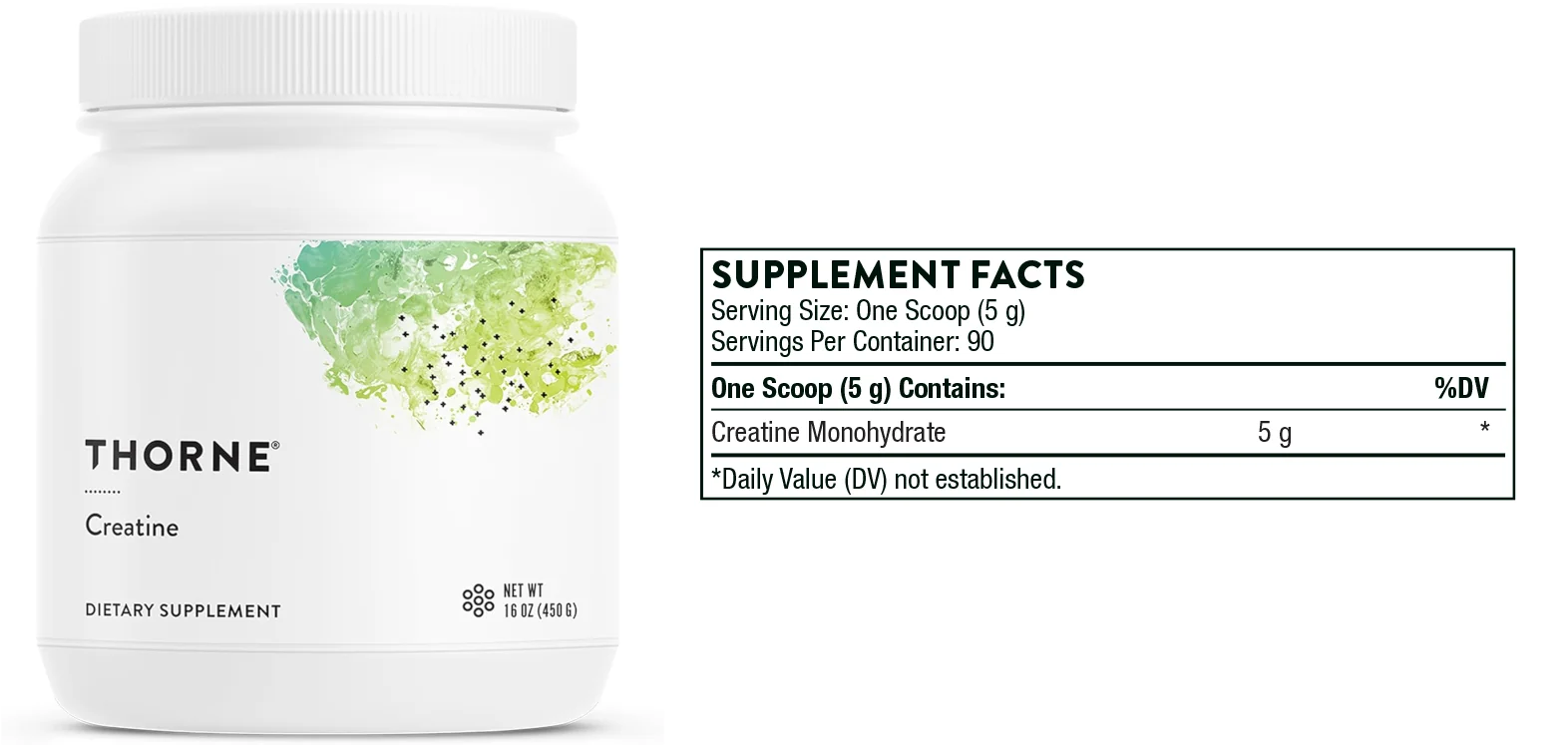
When Rhonda started taking Thorne’s creatine they were using Creapure’s patented version, which is supposed to be good at reducing contaminants. They’ve since switched away from Creapure, so Rhonda had planned to move to Momentous’ Creatine – which were using it. However, Momentous have now also switched away from Creapure – so I’m unsure which version she’ll be using going forward.
We’ve linked below to other brands that use Creapure, so they could be worth taking a look.
Powders - Creatine Monohydrate
| Brands | Quantity | Price per gram |
|---|---|---|
| Nutricost | 500 g | $0.04 |
| NOW | 500 g | $0.06 |
| Momentous Creatine | 450 g | $0.09 |
Capsules - Creatine Monohydrate
| Brands | Quantity | Price per gram |
|---|---|---|
| Nutricost | 500 x 750 mg capsules | $0.07 |
| California Gold Nutrition | 240 x 750 mg capsules | $0.10 |
If buying from iHerb links above, see this 5-20% iHerb discount coupon.
In terms of how she takes the creatine:
- Rhonda mentions commonly putting it into her coffee. I haven’t seen her mention how else she consumes creatine. I assume she must put it into water or other drinks also, as it won’t just be coffee.
- She notes that, according to discussions with Darren Kandow, the heat from coffee won’t damage the creatine. That would only occur if the creatine was boiled for a prolonged period.
- She says she does not have GI issues, so she doesn’t need to take it with food/carbs.
Infographic on Rhonda’s creatine protocol:

How Rhonda Consumes Creatine
In terms of how she takes the creatine:
- Rhonda mentions commonly putting it into her coffee. I haven’t seen her mention how else she consumes creatine. I assume she must put it into water or other drinks also, as it won’t just be coffee.

She notes that, according to discussions with Darren Kandow, the heat from coffee won’t damage the creatine. That would only occur if the creatine was boiled for a prolonged period.
She says she does not have GI issues, so she doesn’t need to take it with food/carbs.
Why Creatine Works for Muscle (Not How You Think)

A common misconception is that creatine directly builds muscle the way protein does. Patrick clarifies that creatine is not anabolic in that sense – it doesn’t stimulate muscle protein synthesis.
Instead, creatine is stored as creatine phosphate in cells, where it’s used to produce energy. With higher creatine stores, muscles have more fuel available during training, which means more reps and higher training volume. That increased volume is what drives muscle growth – the creatine itself is just enabling more work.
This distinction matters for setting expectations. Taking creatine without training won’t build muscle. No workout, no benefit.
At a standard dose of 5 grams per day, it takes about 3 to 4 weeks for muscle creatine stores to fully saturate.
Creatine for the Brain: The “Stressed Brain” Framework
Patrick’s interest in creatine has shifted increasingly toward the brain. The evidence for cognitive benefits in healthy, well-rested people is mixed – some studies show improvements in mental fatigue and processing speed, others find no effect. But Patrick notes creatine is most likely to help when the brain is under stress – sleep deprivation, aging, restrictive diets, or injury.

Part of the reason is how creatine reaches the brain. The body synthesizes roughly 1 gram per day, primarily in the liver and kidneys (Ostojic, 2021). The brain makes its own creatine too, but is resistant to absorbing supplemental creatine. At a 5 gram daily dose, muscles are “greedy” and take most of it, leaving little for the brain.
A German study (Dechent et al., 1999) showed supplementation increased brain creatine levels by up to 10%. Patrick notes this was small and needs replication, and that the optimal brain dose hasn’t been established. Her rationale for 10 grams daily is that doses above 5 grams exceed what muscles absorb, making more available for the brain.
Where the evidence is more consistent is under demand – sleep deprivation, traumatic brain injury, cognitive decline with aging, or diets low in creatine. In those states, energy requirements spike and creatine appears to help. Patrick also notes early data suggesting creatine may affect inflammatory processes, though she emphasizes this is preliminary.
High-Dose Creatine for Cognitive Performance
Several studies have tested creatine at doses of 20 grams or more for brain-related outcomes. Below are the key findings Patrick highlights – covering sleep deprivation, Alzheimer’s disease, and traumatic brain injury.
Sleep deprivation: A German study (Gordjinejad et al., 2024) gave subjects a single dose of 0.35 g/kg creatine (roughly 20-25g for most adults) during 21 hours of sleep deprivation. Those receiving creatine didn’t just maintain cognitive performance – they exceeded their rested baseline, with improvements in processing speed. Brain scans showed creatine prevented the drop in brain pH that typically accompanies sleep deprivation. This is the study behind Patrick’s practice of taking 20-25 grams when traveling or sleep deprived.
Alzheimer’s disease: The first pilot study of creatine in Alzheimer’s patients (Smith et al., 2025) gave 20 adults with early-stage disease 20 grams per day for 8 weeks. Brain creatine increased by 11% on average, and cognitive scores improved – including a 17% gain in working memory. There was no placebo group, which Patrick flags as a significant limitation, but she considers the results promising given creatine’s low cost and established safety.
Patrick has a personal stake here – she carries at least one APOE4 allele, which raises her genetic risk for Alzheimer’s. This makes the neuroprotective research directly relevant to her own health strategy.
Traumatic brain injury in children: A pilot study of 39 children and adolescents with TBI (Sakellaris et al., 2006) found that 0.4 g/kg of creatine daily for 6 months improved cognitive functioning, self-care, and communication compared to controls. A follow-up showed reduced headaches, dizziness, and fatigue in the creatine group.
Creatine Gummies

Rhonda says (in Q&A #75) she’s not a fan of creatine gummies for 3 key reasons:
- To make gummies, as part of the process, you have to heat the gelatin or pectin base to around 70-90°C. With vitamins, this can stop them working. However, creatine is relatively heat stable, but it does have another issue. If you subject it to heat + moisture it can convert to creatinine – a product that doesn’t have the benefits of creatine. This could (and can) happen with your gummies.
- Multiple recent analysis have found the majority of creatine gummies they tested have little to zero creatine in them.
- Assuming you find gummies that contain the amount of creatine they purport to, you still have the issue that you need to eat a lot of gummies to get to the 5g – 10g daily dose that she’s using.
Roundup
Patrick takes 10 grams of creatine monohydrate daily (Thorne, Creapure), split into two doses. When traveling or sleep deprived, she increases to 20-25 grams.
Her interest in creatine has expanded well beyond muscle. The emerging research on brain benefits under stress – sleep deprivation, cognitive decline, traumatic brain injury – is what drives her higher dosing. She’s upfront that much of this research is early and based on small studies, but given creatine’s decades-long safety record, she considers the risk-reward ratio favorable.
For more detail, see the creatine topic on her site.
Further reading:
- Rhonda’s full supplement stack
- Stacy Sim’s approach to creatine (a lot of overlap)
Disclaimer: The above information is for research and educational purposes only and not a substitute for professional medical advice. See full medical disclaimer.
Note: We have no affiliation with Rhonda Patrick - this article is based on publicly shared information.