Bryan Johnson takes 7.5 g of creatine a day, spread across two products he takes.
In this article we’ll look at his exact creatine routine and how the dose holds up against the research, including a trial his own team shared on their podcast.
TLDR: Bryan Johnson Creatine Protocol
- What he takes: 7.5 g a day, 5 g from a standalone scoop plus 2.5 g inside Longevity Mix, taken around 5:25 AM pre-workout.
- The product: Plain creatine monohydrate at 5 g per scoop, third-party tested with a Certificate of Analysis.
- The muscle question: A 2025 trial at 5 g/day found no lean-mass advantage over training alone, and Blueprint’s own chief medical officer says the muscle evidence was never strong.
- Dosing guidance: Around 0.1 g per kilo of body weight, so about 7 g for a 70 kg adult, with 5 g called adequate for most people and no loading phase needed.
- Brain benefits: Blueprint claims 5 g supports focus and memory, but the independent evidence at that dose in healthy adults is thin.
- Blood-work caveat: Creatine raises serum creatinine and can drag a creatinine-based kidney estimate down without anything being wrong.
Dosage
He takes two products together. One is a standalone scoop of Blueprint Creatine at 5 g, the other is a scoop of Blueprint Longevity Mix carrying a further 2.5 g. That totals 7.5 g a day (source).
He has given the same figures on his own podcast, where he also put his weight at 77 kg (source).
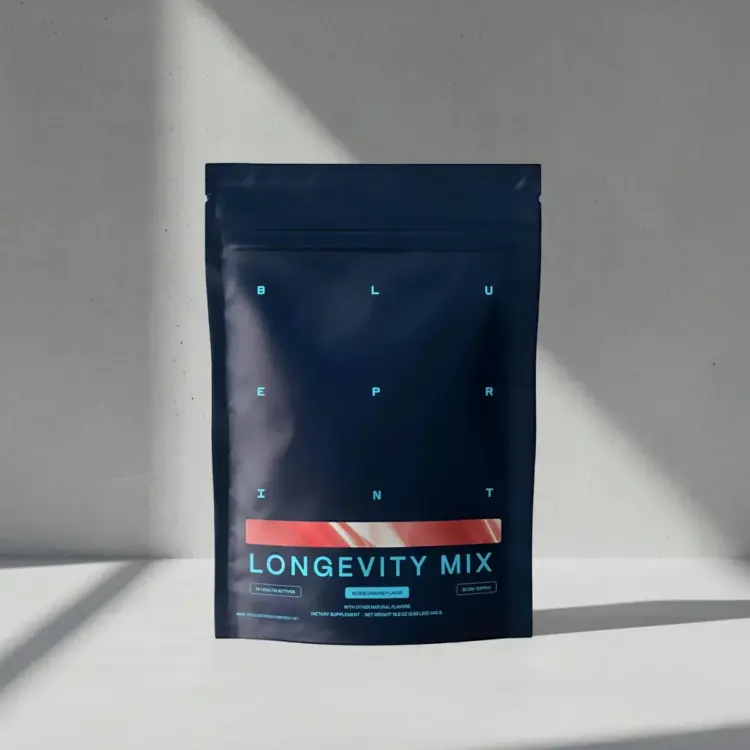
Creatine is one piece of a much larger Blueprint protocol. It goes into a 5:25 AM pre-workout drink, 8 oz of liquid carrying:
- Longevity Mix: One scoop, bringing creatine monohydrate 2.5 g, calcium alpha-ketoglutarate 2 g, taurine 1.5 g, glycine 1.2 g, L-lysine HCl 1 g, glucosamine sulfate 750 mg and L-glutathione 250 mg
- Creatine: 5 g, the standalone scoop
- Prebiotic galactooligosaccharides: Half a teaspoon
- Inulin: One teaspoon
- Arabinogalactan powder: One teaspoon
Breakfast lands ten minutes later. It’s Blueprint’s Longevity Protein with berries, a blueberry nut mix and 11 g of collagen peptides. The tablespoon of Blueprint extra virgin olive oil is taken on its own (source).
Hear him name creatine as his muscle-growth supplement here.
Blueprint Creatine
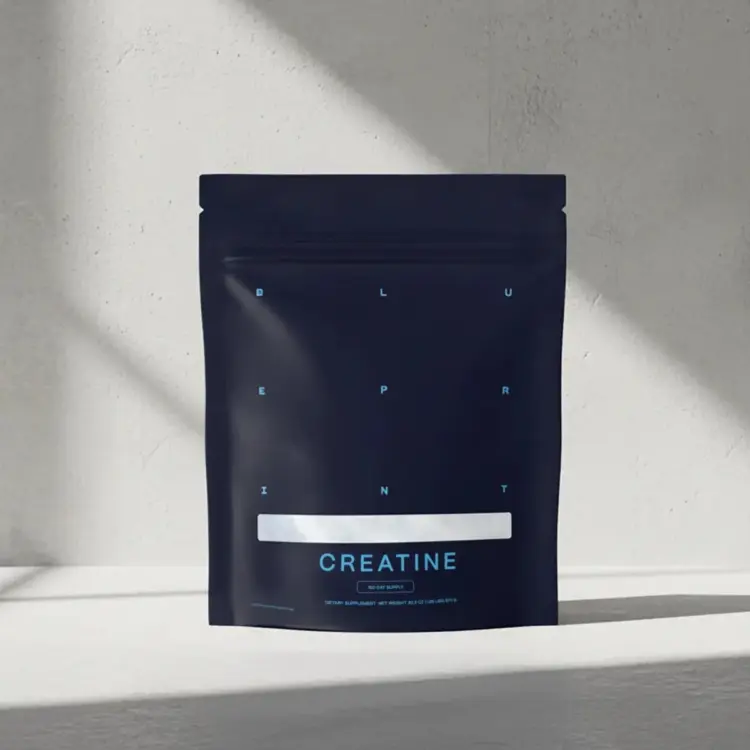
The 5 g scoop is Blueprint Creatine, sold by Bryan Johnson’s own company. It’s plain creatine monohydrate rather than one of the newer salts or esters, which is the form nearly all the research runs on.1International Society of Sports Nutrition Position Stand: Safety and Efficacy of Creatine Supplementation in Exercise, Sport, and Medicine | Kreider et al. | 2017 | Journal of the International Society of Sports Nutrition
- Serving: One scoop delivers 5 g of creatine
- Container: 100 servings
- Testing: Third-party tested for purity and heavy metals, with a Certificate of Analysis to download
Blueprint’s own directions are one scoop in 8 oz of milk, water or another beverage, pre or post workout.
Other creatine options worth considering:
Capsules - Creatine Monohydrate
| Brands | Quantity | Price per gram | Discount Code |
| Nutricost | 500 x 750 mg capsules | $0.07 | - |
| California Gold Nutrition | 240 x 750 mg capsules | $0.10 | (see 20% off iHerb coupon) |
| Momentous Creatine | 150 x 1000 mg capsules | $0.33 |
Powders - Creatine Monohydrate
| Brands | Quantity | Price per gram |
| Nutricost | 500 g | $0.04 |
| NOW | 500 g | $0.06 |
| Momentous Creatine | 450 g | $0.09 |
Creatine And Muscle Growth
In June 2025 a creatine study became the topic of the week on Bryan Johnson’s Don’t Die Podcast, and it was not a flattering one. At the standard 5 g daily dose, it found no more muscle than training alone.
The trial ran like this:2The Effect of Creatine Supplementation on Lean Body Mass with and Without Resistance Training | Desai et al. | 2025 | Nutrients
- 63 adults, mean age 31
- 5 g/day of creatine monohydrate
- A 7-day wash-in, then 12 weeks of supervised resistance training
- Both arms gained the same lean mass, around 2 kg
Bryan Johnson widened the frame rather than defending the dose, noting that creatine has very broad appeal and is taken also for cognitive benefits.
The analysis came from Dr Mike Mallin, Blueprint’s chief medical officer and a former ER physician. His technical objection is that a 7-day wash-in is too short, because at 5 g/day without a 20 g ramp it takes three to four weeks to saturate the muscles.
Then he conceded the larger point. The data showing creatine actually increases muscle mass “was never actually that good”, he said, with the earlier studies showing very small changes.
Listen to the moment the muscle-mass evidence gets called weak here. This clip starts at ≈15:45.
Dr Mike Mallin also noted what the trial never measured, which was cognitive function, recovery, power and strength output. It wouldn’t change a thing about his own creatine intake, he said.
What Blueprint’s Doctor Suggests
The dosing guidance on that episode is Dr Mike Mallin’s rather than Bryan Johnson’s, and it is aimed at a general listener rather than at one protocol:
- Weight-based target: Around 0.1 g/kg/day for general health, which works out to about 7 g/day for a 70 kg adult
- Flat figure: 5 g/day seems adequate for an average-sized human on a normal diet
- Loading: Not necessary, in his view, because starting at 5 g and staying consistent reaches saturation over three to four weeks
Catch the weight-based dosing answer in full here. This clip starts at ≈19:22.
On the weight-based figure, Bryan Johnson’s 77 kg would come to about 7.7 g, so his 7.5 g sits just under it.
Dr Mike Mallin adds that a standard omnivorous diet already supplies roughly 1 to 2 g/day, so a vegan may need more, and that the cognitive trials showing benefit tend to run at 10 to 20 g/day.
Those figures line up with the published literature. The ISSN position stand puts 3 to 5 g/day at muscle saturation in roughly four weeks without a loading phase, and up to 30 g/day for five years in the safe and well tolerated column for healthy people. Anyone with an existing kidney condition sits outside that evidence base.
Other influencers and experts take similar amounts. For example, Joe Rogan, Gary Brecka and Stacy Sims all sit in the standard 3 to 5 g range, while Rhonda Patrick runs 10 g a day, rising to 20 to 25 g when travelling or short on sleep.
The Brain Claim
Blueprint sells creatine partly on cognition. Its own article on creatine claims that “studies show supplementing with 5 g of creatine supports focus and memory in addition to muscle strength”.
That article also explains why the brain comes into it. Roughly 95% of the body’s creatine sits in muscle, with about 5% in the brain and other organs. The body makes some of its own, and plant foods contain none.
Where the signal does show up is under real metabolic stress. A crossover study in 15 participants gave a single 0.35 g/kg dose during 21 hours of sleep deprivation and measured improvements in processing speed and several memory tasks. That works out to roughly 25 g for a 70 kg adult, far above the 5 g on the label.3Single Dose Creatine Improves Cognitive Performance and Induces Changes in Cerebral High Energy Phosphates During Sleep Deprivation | Gordji-Nejad et al. | 2024 | Scientific Reports
Bryan Johnson documents almost everything he does, but he has said very little about creatine in public. His clearest statement came in April 2025, replying to a follower asking about exactly those higher doses.
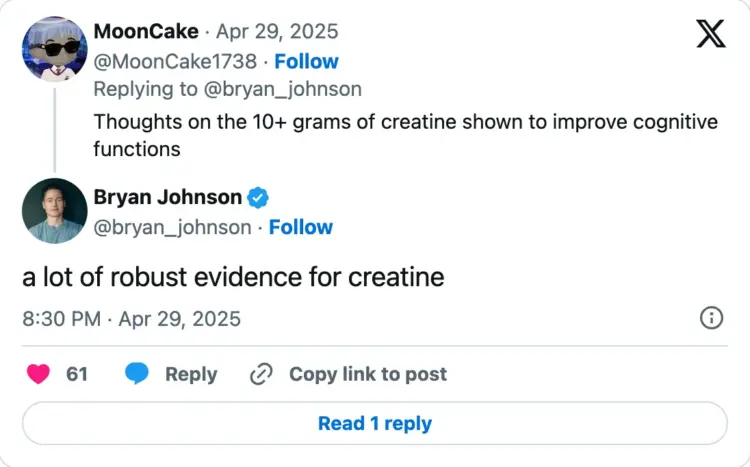
Source: @bryan_johnson on X
He didn’t take up the number. His own 7.5 g sits well below the doses used in those cognition trials.
Creatine And Your Blood Panel
Creatine moves one number on a standard blood panel, and the movement is not what it looks like.
Creatine supplementation raises serum creatinine. Dr Mike Mallin flags it on-air, describing the reading as a little falsely elevated and cautioning against using it to judge whether a dose is right (source).
That caution has a documented mechanism behind it. A meta-analysis of creatine and kidney function found a small but real rise in serum creatinine, while filtration rate itself stayed stable. The authors put the rise down to increased metabolic turnover rather than kidney dysfunction.4Effect of Creatine Supplementation on Kidney Function: A Systematic Review and Meta-Analysis | Naeini et al. | 2025 | BMC Nephrology
That gap matters, because the standard estimated glomerular filtration rate (eGFR) calculation assumes your body produces creatinine at a steady rate, so a supplement-driven rise can drag the estimate down even when filtration hasn’t changed. Cystatin C isn’t affected by muscle mass or supplementation, so it may be the more informative marker.
Hear why a raised creatinine reading isn’t what it looks like here. This clip starts at ≈22:22.
Roundup
Bryan Johnson’s 7.5 g comes from two products rather than one. The dose sits just under the weight-based figure his own doctor suggests, and the form is the plain monohydrate that carries the research.
If you have any questions or comments, please leave them below.
Further Reading
If you found this post on Bryan Johnson’s creatine routine helpful, you may also like:
- Bryan Johnson Supplement List – The whole Blueprint stack, sorted by what each supplement targets.
- Bryan Johnson Peptide List – The peptides in his protocol, what each is aimed at and how they are tested.
- Bryan Johnson Follistatin Gene Therapy – The other muscle-directed intervention he has tried, and the reasoning behind it.
FAQs
Bryan Johnson takes 7.5 g of creatine monohydrate a day, 5 g from a standalone scoop plus 2.5 g inside one scoop of Blueprint Longevity Mix.
He uses Blueprint Creatine, the creatine monohydrate sold by his own company, at 5 g per scoop.
At around 5:25 AM, pre-workout, in 8 oz of liquid with Longevity Mix and prebiotic powders.
Yes. One scoop of Blueprint Longevity Mix contains 2.5 g of creatine monohydrate, alongside calcium alpha-ketoglutarate, taurine, glycine and several other amino acids.
The ISSN position stand states that 3 to 5 g/day reaches muscle saturation in roughly four weeks without one. Blueprint’s chief medical officer Dr Mike Mallin makes the same point.
It affects one of them. Creatine raises serum creatinine, which can drag a creatinine-based eGFR estimate down without indicating kidney injury. A meta-analysis found that the creatinine rise reflects increased metabolic turnover, with filtration rate itself staying stable. Anyone with an existing kidney condition would want to speak to their doctor.
References
- 1International Society of Sports Nutrition Position Stand: Safety and Efficacy of Creatine Supplementation in Exercise, Sport, and Medicine | Kreider et al. | 2017 | Journal of the International Society of Sports Nutrition ↩︎
- 2The Effect of Creatine Supplementation on Lean Body Mass with and Without Resistance Training | Desai et al. | 2025 | Nutrients ↩︎
- 3Single Dose Creatine Improves Cognitive Performance and Induces Changes in Cerebral High Energy Phosphates During Sleep Deprivation | Gordji-Nejad et al. | 2024 | Scientific Reports ↩︎
- 4Effect of Creatine Supplementation on Kidney Function: A Systematic Review and Meta-Analysis | Naeini et al. | 2025 | BMC Nephrology ↩︎
Disclaimer: The above information is for research and educational purposes only and not a substitute for professional medical advice. See full medical disclaimer.