Rhonda has always been interested in filtering her tap water. Her initial approach to this was a gravity fed carbon filter system made by Berkey, however since then she has moved to reverse osmosis.
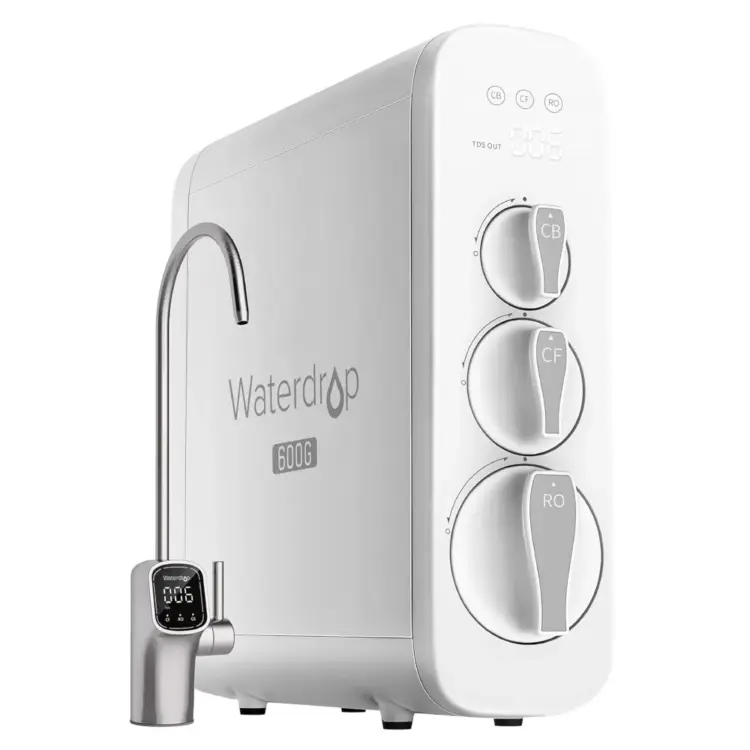
In June 2026 (Q&A #82) the reverse osmosis system she names when asked is the WaterDrop G3P600.
Below we’ll look in more detail at the system she uses.
Reverse Osmosis
Asked in June 2026 to name “your reverse osmosis system that doesn’t have any plastic parts in it”, she answered: “So the one that I am pretty bullish on is the WaterDrop G3P600 reverse osmosis system. It’s an eight stage tankless reverse osmosis water filter” (source Q&A #82).
On the terms: tankless means it filters on demand rather than holding filtered water in a storage tank, which is relevant to the question she was answering about plastic parts, and eight-stage is the number of filtration steps, one of them the reverse osmosis membrane itself.
In terms of installation, the filter needs plugging into the mains, it sits under the sink and comes with a separate tap that requires fitting.
Besides this brand, in her 2025 Q&A she called APEC and AquaTru “two countertop reverse osmosis water filters that seem to be pretty good”. Noting AquaTru the more popular of the two among her audience.
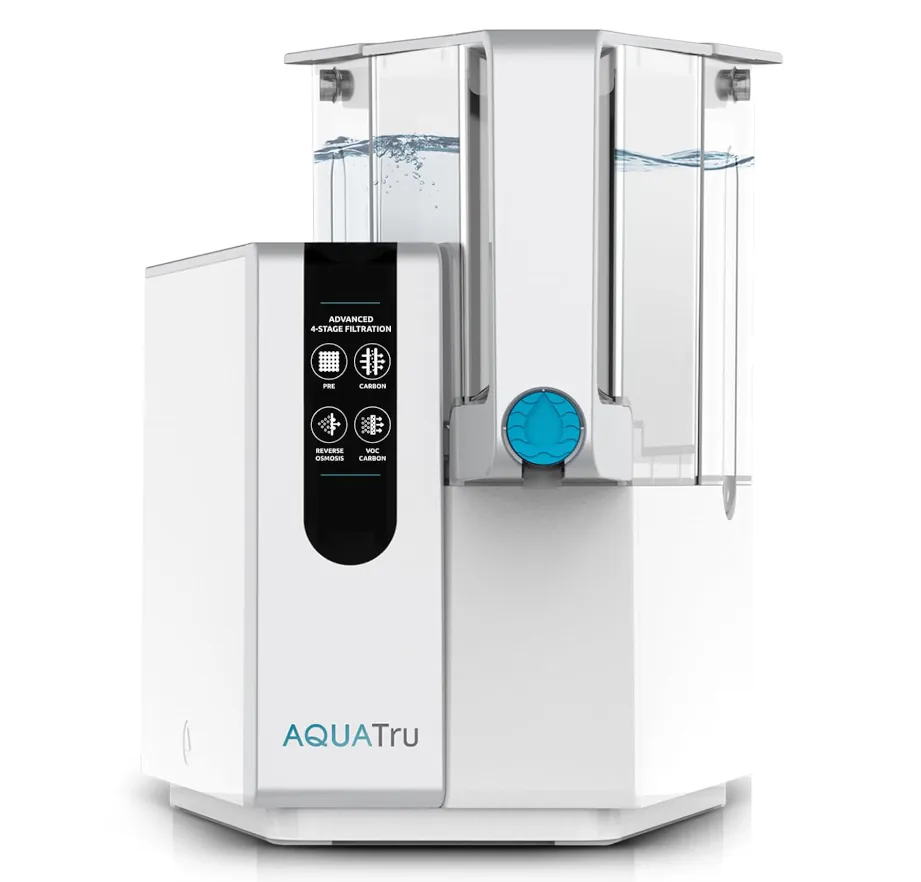
AquaTru make the AquaTru Classic Countertop reverse osmosis filter (above).
- The pro is that you don’t need to plumb it in ✅
- The trade-off is that it takes up space, requires refilling and your water sits in plastic prior ❌ Granted it’s “Tritan plastic”, which is BPA/BPS-free.
Remineralisation
Reverse osmosis strips minerals, which was originally her reason for not switching: “The concern that I have with reverse osmosis filters is they remove all the minerals and trace elements. And I think that those are important” (Q&A 57, March 2024).
When she first moved to using reverse osmosis she supplmented using Pure Encapsulations Mineral 650 product, calling it “essentially almost like made for someone that uses reverse osmosis water filtration system”.
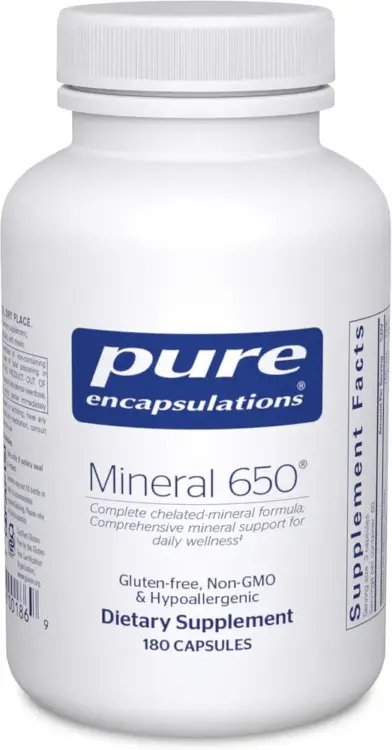
Then in June 2026 she stopped: “I don’t take any of those capsules. I don’t take that mineral 650.”
Deeper research had shown her that her multivitamin already covered most of what reverse osmosis removes. The three it didn’t were calcium, magnesium and potassium, and she already supplements magnesium and gets calcium and potassium from a greens smoothie plus yogurt and cottage cheese, which she considers the easiest three to get from diet anyway. That is what she concluded for her own diet rather than a template; her wider approach to food is in our article on Rhonda’s diet and exercise.
Why she left Berkey
The trigger was a trust problem, not a filtration one. In Q&A 58 (April 2024) she described a deep dive she and her team had done into the company:
- No NSF certification. NSF is an independent body that tests water treatment products against published standards. She said Berkey was refusing to get certified, citing red tape and cost, and that the bar isn’t high: “there’s a lot of small mom and pop companies that do it.”
- Testing that didn’t line up. She said New York Times-commissioned studies produced data that “didn’t necessarily correlate to what Berkey was saying”, slightly higher chloroform being her example, and that other independent testers were publishing their own results and asking why Berkey wasn’t doing the same.
- An EPA episode. She said the company had a period of not complying with the EPA.
Microplastics came second, and she flagged it as second herself: “Oh, and the other thing that really switched me over is that reverse osmosis really does filter out microplastics” (Q&A 58, April 2024).
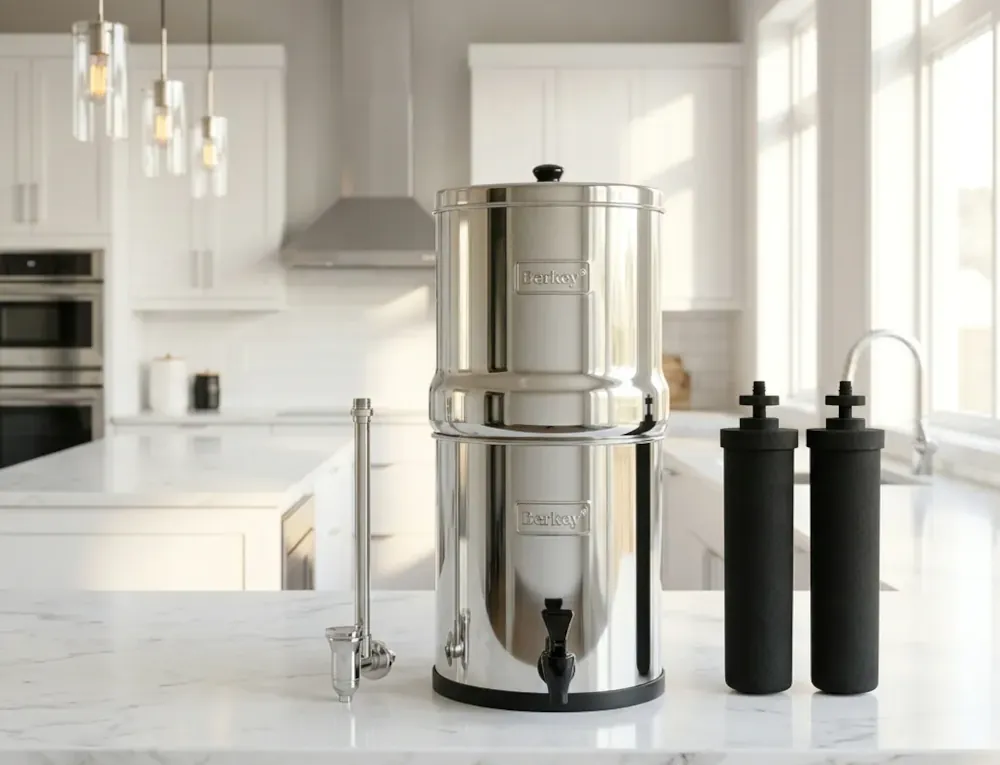
Of course, the practical upside to a gravity-fed water filter like Berkey is that you don’t require any modifications to the sink, and you can easily move them between locations.
Carbon filters, pitchers and fridge filters
Separately from anything about Berkey, she has twice described the general limits of activated carbon.
In Q&A #68 she said a carbon filter is “great for getting rid of the plastic associated chemicals like BPA, BPS”, but on microplastics and nanoplastics “it’s not going to do the job”, allowing only that it may catch “perhaps larger plastic particles”.
She avoids plastic pitchers outright: “I don’t want my water in plastic at all” (Q&A 58, April 2024). We’ve covered microplastics in disposable coffee cups separately.
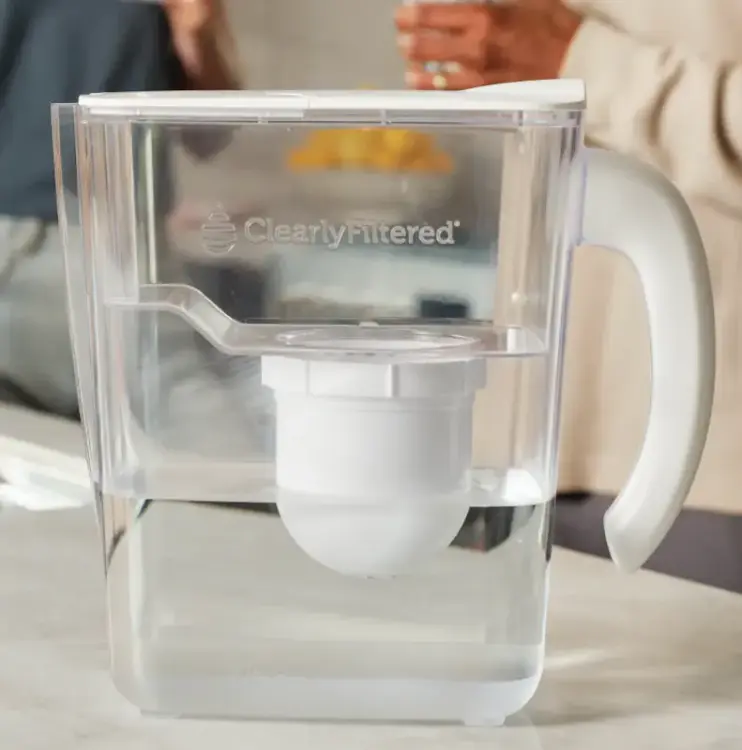
The same size logic runs through her April 2026 answer on fridge filters. It depends on the fridge, she said: systems vary model to model and some do use reverse osmosis, and a non-reverse-osmosis one is still beneficial, removing plenty including some larger microplastics. What it may not be catching is nanoplastics.
Roundup
Above we’ve covered Rhonda’s transition from gravity-fed charcoal filters to reverse osmosis. From the use of remineralisation supplements to an estimate that her supplements and diet are adequate to cover any shortfall.
If you’ve any questions or comments, please leave them below.
Disclaimer: The above information is for research and educational purposes only and not a substitute for professional medical advice. See full medical disclaimer.
Note: We have no affiliation with Rhonda Patrick - this article is based on publicly shared information.