In this article we’ll look at the creatine Joe Rogan takes himself, why he trusts it, and what the research supports for both muscle and the brain.
Creatine is the one supplement Joe Rogan keeps coming back to. He calls it one of the safest things you can take, keeps a bag in his personal gym and another in his car, and argues that it does a lot more than build muscle.
TLDR: Joe Rogan’s Creatine Protocol
- What he takes: Creatine gummies, which he refers to as “tri-creates.” He previously used Onnit creatine monohydrate powder at roughly 5 grams a day.
- Other creatine brands: A few well-researched options beyond what Rogan uses, covering different formats and price points.
- Why he trusts it: Safety. He calls creatine one of the safest supplements, with a long research record and no real downside for healthy people.
- The brain angle: In a conversation with Elon Musk, he framed creatine as a nootropic, with the strongest case during sleep deprivation.
- Women over 40: This is where he’s most emphatic in conversation with Gary Brecka, pointing to both cognitive and physical benefits, especially for postmenopausal women.
- What the science says: 3 to 5 grams a day is the evidence-based dose for muscle. Cognitive effects at that dose are modest; the stronger brain effects show up at higher doses or under sleep deprivation.
- Food source: Creatine occurs naturally in meat and fish. Eat less than a pound or two a day and you’re likely below full saturation.
What Joe Rogan Takes
Rogan takes creatine in gummy form, referring to them as “tri-creates,” and says he keeps a bag in the gym. He credits the format for making him more consistent with creatine than ever. The specific brand wasn’t identified. (source)
Before gummies, he used Onnit creatine monohydrate powder(see 20% off iHerb coupon) at roughly 5 grams a day.
The switch to gummies was about consistency, not chemistry. Gummies still contain creatine monohydrate; they just package it differently.
Rogan says the gummy format is what keeps him consistent with creatine. He’s never had a problem with it on his stomach, and having them easy to grab means he takes them more regularly than he ever did with powder. He keeps a pouch at the gym and just opens it up when he’s there.
Listen to the full segment here.
Examples of how famous biohackers use Creatine:
- Gary Brecka: Around 5 grams a day of creatine HCl. He favours Cymbiotika and Rho Nutrition for their clean formulas.
- Rhonda Patrick: 10 grams of monohydrate daily, split into two doses. She uses Thorne Creatine and plans to switch to Momentous.
- Stacy Sims: 3 to 5 grams of monohydrate daily, no loading phase. She points to Momentous and Creapure-based products.
- Bryan Johnson: 7.5 grams a day, split across his Longevity Mix and Blueprint Creatine.

Common Creatine Brands Worth Knowing
Capsules - Creatine Monohydrate
| Brands | Quantity | Price per gram |
|---|---|---|
| Nutricost | 500 x 750 mg capsules | $0.07 |
| California Gold Nutrition | 240 x 750 mg capsules | $0.10 |
Powders - Creatine Monohydrate
| Brands | Quantity | Price per gram |
|---|---|---|
| Nutricost | 500 g | $0.04 |
| NOW | 500 g | $0.06 |
| Momentous Creatine | 450 g | $0.09 |
When comparing, the things that matter are the form (monohydrate has by far the most research behind it), third-party testing, and price per gram.
Why He Trusts Creatine
Joe Rogan’s case for creatine starts with safety. He’s described it plainly as very safe, and as one of the safest supplements out there. For training specifically, he’s called it one of the very best things you can take if you’re lifting weights. That confidence lines up with the research, which spans more than 1,000 studies on creatine monohydrate.
Hear the full clip here.
A few reasons it earns his trust:
- It’s effective for muscle. Creatine reliably supports strength and training performance, which is the benefit it’s best known for.
- It’s safe long-term. There’s no credible evidence of kidney damage, cramping, or dehydration in healthy individuals.
- It’s consistent. He doesn’t get GI issues, so there’s nothing putting him off taking it every day.
Rogan also makes the point that creatine is, in effect, a food component rather than an exotic compound. As he put it to Elon Musk, it’s a natural part of food, so there are no downsides (source).
The Cognitive Angle
Rogan’s most recent creatine enthusiasm centres on the brain, not the gym.
In a conversation with Elon Musk, Musk floated the idea that creatine is actually a nootropic, “believe it or not,” and that it’s not just for bodybuilders. Rogan ran with it, noting that mental performance when sleep-deprived increases measurably with creatine (source).
Watch the full conversation here. This segment begins at ≈1:56.
Joe Rogan has said a single high dose of creatine can temporarily improve cognitive performance during sleep deprivation, and he attributes it to a few things creatine does inside cells:
- It prevents a drop in pH, which helps cells keep working under stress.
- It improves processing speed.
- It increases energy availability inside the cell (source).
The sleep angle is the one he keeps returning to. He believes creatine is one of the few things shown to blunt the effects of sleep deprivation on the mind.
Creatine for Longevity
The most detailed version of this argument came from nutritional scientist Chris Masterjohn, who appeared on JRE and put creatine in a whole-body context rather than a muscle one.
His framing: mitochondria are the powerhouse of the cell, and creatine is the power grid that distributes that energy throughout it. Almost every cell and tissue has the creatine system, he noted, from muscle to the retina.
On dosing, Masterjohn made a point that matters for the brain conversation. Most brain research uses higher doses, in his account around 20 grams. In his view, the muscles take first dibs at standard doses, so you need more to get meaningful amounts to the brain. That last point is his own reasoning from the conversation rather than a settled, citable finding.
He also described a sleep deprivation study where subjects were kept awake all night and given either a placebo or creatine. Masterjohn described the dose as roughly 20 grams. The creatine group did markedly better on brain puzzles and complained of tiredness less.
See the full discussion here. This segment begins at ≈2:37.
Creatine for Women Over 40

In a conversation with Gary Brecka on the podcast, Rogan explored who stands to benefit most from creatine. Brecka singled out women 40 and older as a group that should particularly consider it, pointing to benefits for both physical health and cognitive function, including during sleep deprivation.
In his conversation with Elon Musk, he singled out postmenopausal women as a group it may especially suit.
There’s real research behind the emphasis, and bone is the area that’s been studied most:
- Less bone loss with training. In postmenopausal women, creatine combined with resistance training points to less bone loss than training alone.
- The trial numbers. In one study, women on creatine plus resistance training lost 1.2% of bone mass at the femoral neck over the study period, compared with 3.9% in the placebo group.1Effects of Creatine and Resistance Training on Bone Health in Postmenopausal Women | Chilibeck et al. | 2015 | Medicine & Science in Sports & Exercise
- The dose. The reviewed dose in this space sits at the standard 2 to 5 grams a day.
So while Rogan states it bluntly, the underlying suggestion, that creatine plus training may suit women navigating menopause, has support worth taking seriously.
Catch the full exchange here.
What the Science Actually Supports
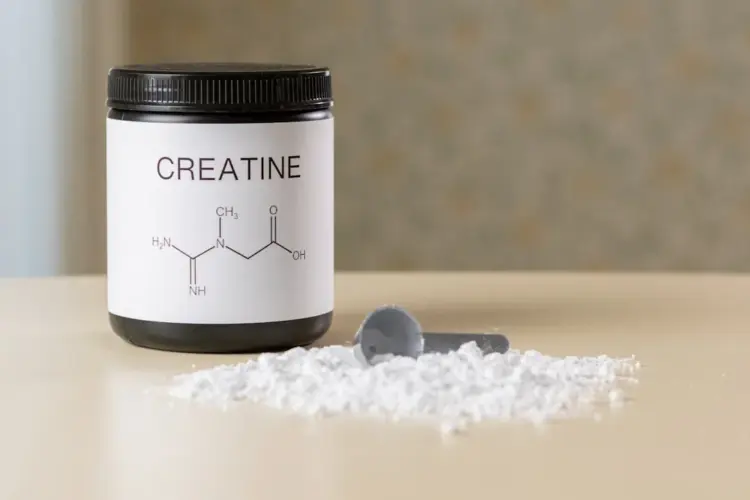
Rogan’s enthusiasm is broadly in line with the evidence, but the strength of that evidence depends heavily on the dose and the outcome.
Muscle and Performance
The standard maintenance dose is 3 to 5 grams a day of creatine monohydrate. The International Society of Sports Nutrition’s position draws on more than 1,000 studies and treats this as settled for strength and performance.2International Society of Sports Nutrition position stand: safety and efficacy of creatine supplementation in exercise, sport, and medicine | Kreider et al. | 2017 | Journal of the International Society of Sports Nutrition
Safety
The same body of work finds no credible evidence of kidney harm, cramping, or dehydration in healthy people, even with long-term use. This is the part Rogan gets most right.
Cognition at 5 grams
A 2023 randomised controlled trial gave 123 healthy adults 5 grams a day for 6 weeks. Working memory improvement only “bordered on significance” (p=0.064), and there was no clear effect on abstract reasoning.3The effects of creatine supplementation on cognitive performance—a randomised controlled study | Sandkühler et al. | 2023 | BMC Medicine The authors called for larger studies. So at everyday doses, the cognitive benefit is real-but-small at best.
Cognition at higher doses
The more striking effects appear at higher doses, or in specific conditions like sleep loss. A 2024 study found that a high single dose (around 0.35 grams per kilogram of bodyweight, roughly 24 to 25 grams for a 70kg person) improved cognitive performance during sleep deprivation4Single dose creatine improves cognitive performance and induces changes in cerebral high energy phosphates during sleep deprivation | Gordijnejad et al. | 2024 | Scientific Reports. This fits Masterjohn’s point that the brain needs a bigger dose because muscle claims it first. Brain creatine stores themselves rise only around 5 to 15% with supplementation.
One important caveat is that a high single dose like that is a research and therapeutic dose, not an everyday recommendation. The studies showing strong brain effects use it under specific conditions. For ordinary daily use, 3 to 5 grams remains the figure the evidence supports.
Creatine in Food
Creatine isn’t only a supplement. It occurs naturally in red meat and fish, a point Musk raised and Rogan confirmed in their exchange.
The catch is quantity. Getting a meaningful daily amount from food alone takes a lot of meat. As Masterjohn put it, anyone not eating roughly one to two pounds of meat a day is probably below full creatine saturation, which is the gap a supplement fills.
A couple of practical notes from that same discussion:
- Cooking matters. Heat reduces the creatine in meat, so well-done leaner cuts deliver less than rarer ones.
- Fish counts. Salmon and other fish carry creatine too, which is why the “meat or fish” framing comes up rather than red meat alone.
For most people eating a normal mixed diet, you’re getting some creatine from food, just not as much as the studied supplement doses provide.
Roundup
Joe Rogan’s creatine story is a useful one because it tracks how the wider conversation has shifted. He started out treating creatine as a safe, effective muscle supplement, and still does, but the bulk of his recent enthusiasm is about the brain: sleep deprivation, cognitive function, and benefits for women over 40, a point raised by Gary Brecka in one of their conversations.
His current protocol is creatine gummies, chosen mostly because they keep him consistent. The science backs the muscle and safety claims firmly, supports the women’s health angle, and is genuinely promising on cognition, though the strongest brain effects need higher doses than the everyday 3 to 5 grams. As Rogan himself frames it, creatine is less a magic bullet and more a low-risk nutrient most people are mildly short on.
Creatine is just one part of what Rogan takes. For the complete picture of his supplement stack, Joe Rogan’s supplement list covers everything else he uses and why.
If you’ve questions about Rogan’s protocol or the research, please leave them in the comments below.
Thumbnail: “Joe Rogan” by Daniel Torok (Official White House Photo, Public Domain)
Further Reading
If you found this useful, you may also enjoy:
- Joe Rogan’s Peptides – His BPC-157 and TB-500 recovery stack, and why he calls it the “Wolverine Stack.”
- Joe Rogan’s Diet – How his meat-heavy eating habits tie into his naturally higher creatine baseline.
- Joe Rogan’s TRT Protocol – His testosterone replacement therapy journey, from topical creams to injections, and the supporting supplements he uses.
- Joe Rogan on Methylene Blue – Another supplement he’s discussed on the podcast, this time for mitochondrial support and energy.
- Andrew Huberman Supplements List – How a neuroscientist builds his supplement stack, with creatine among the compounds he’s used.
FAQs
Joe Rogan currently takes creatine gummies, referring to them as “tri-creates.” Before switching to gummies he used Onnit creatine monohydrate powder, the brand from the supplement company he co-founded (source).
Joe Rogan hasn’t specified how many gummies he takes daily. His earlier powder protocol was roughly 5 grams a day, which is in line with the 3 to 5 grams the research supports for muscle and performance (ISSN).
Yes. Gummies are his current format, and he’s said he’s more consistent with creatine than ever because they’re so easy to grab. He keeps a bag in his gym and one in his car.
In a JRE conversation, Musk called creatine “actually a nootropic,” arguing it isn’t just for bodybuilders. Rogan agreed and added that mental performance under sleep deprivation improves measurably with creatine, and that it occurs naturally in meat (source).
The evidence suggests a modest benefit at everyday doses and a stronger one at higher doses or under sleep deprivation. A 2023 trial at 5 grams a day found only borderline working-memory improvement (BMC Medicine), while higher-dose and sleep-deprivation studies show clearer effects (Scientific Reports 2024).
Research points to benefits for women, particularly postmenopausal women, where creatine combined with resistance training may reduce bone loss (Chilibeck et al. 2015). Rogan is emphatic on this point, but whether it suits any individual is best discussed with a doctor.
References
- 1Effects of Creatine and Resistance Training on Bone Health in Postmenopausal Women | Chilibeck et al. | 2015 | Medicine & Science in Sports & Exercise ↩︎
- 2International Society of Sports Nutrition position stand: safety and efficacy of creatine supplementation in exercise, sport, and medicine | Kreider et al. | 2017 | Journal of the International Society of Sports Nutrition ↩︎
- 3The effects of creatine supplementation on cognitive performance—a randomised controlled study | Sandkühler et al. | 2023 | BMC Medicine ↩︎
- 4Single dose creatine improves cognitive performance and induces changes in cerebral high energy phosphates during sleep deprivation | Gordijnejad et al. | 2024 | Scientific Reports ↩︎
Disclaimer: The above information is for research and educational purposes only and not a substitute for professional medical advice. See full medical disclaimer.
Note: We have no affiliation with Joe Rogan - this article is based on publicly shared information.

.jpg)