Status last checked: September 2026
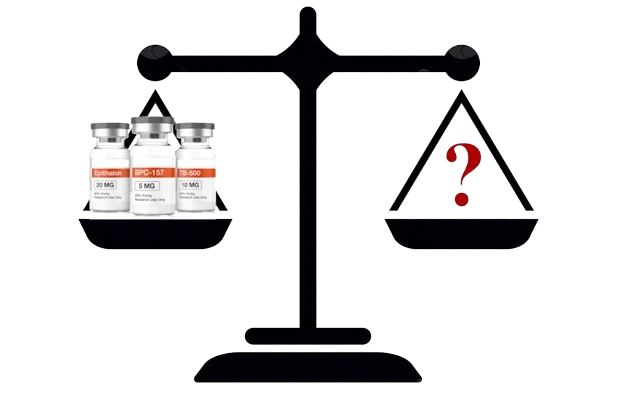
The legal status of peptides in the US has been shifting since 2023, and it changed again in 2026. This page tracks where the peptides covered on Fast Life Hacks currently stand, from BPC-157 and TB-500 to CJC-1295, ipamorelin and sermorelin.
This isn’t legal advice. It summarizes public FDA information as of the date above. For the UK picture, see Are Peptides Legal in the UK?
Are Peptides Legal in the US? The Short Answer
- Most popular wellness peptides aren’t FDA-approved drugs. That includes BPC-157, TB-500, CJC-1295 and ipamorelin, so they can’t legally be sold as medicines in the US.
- They can’t be sold as supplements either. Dietary supplements must be taken by mouth, which rules out injectables. Oral BPC-157 is ruled out too: the Defense Department’s supplement safety program states it isn’t a dietary ingredient.
- US pharmacies can’t currently compound most of them. A pharmacy can only compound with an ingredient that qualifies through one of a few FDA routes, and most of these peptides don’t as of September 2026. Sermorelin is the main exception.
- Among the wellness peptides in the table below, only two are FDA-approved medicines: tesamorelin (Egrifta) and PT-141 (Vyleesi). They’re legal on prescription as the approved product. The same compounds sold by peptide vendors aren’t.
- Branded GLP-1s (Ozempic, Wegovy, Mounjaro, Zepbound) are legal on prescription. Compounded copies are now tightly limited. See compounded GLP-1s below.
- Much of the market sits in a gray area. That covers “research use only” sellers and clinics prescribing peptides that aren’t cleared for compounding. See the gray area below.
- Things are moving, slowly. In 2026 the FDA took several peptides off its restricted list, and an FDA advisory panel backed allowing BPC-157. Any change to what pharmacies may use still needs further FDA action, typically a formal rule, which can take a year or more.
Which Peptides Does This Page Cover?
“Peptide” just means a short chain of amino acids, so the word covers very different products:
- Prescription peptide drugs such as insulin and the GLP-1 weight-loss drugs semaglutide (Ozempic, Wegovy) and tirzepatide (Mounjaro, Zepbound). These are FDA-approved and legal on prescription. Compounded versions have their own rules, covered in a section below.
- Collagen and cosmetic peptides, such as collagen powders and peptide skincare serums. These are sold legally as supplements or cosmetics, as long as they aren’t marketed to treat a medical condition.
- Wellness and “research” peptides such as BPC-157, TB-500 and CJC-1295, usually injected and mostly not approved. Most of this page is about these.
Which Peptides Are Legal? Status of Each Peptide
| Peptide | FDA-approved? | Can a pharmacy compound it on prescription? |
|---|---|---|
| BPC-157 | No | No. Off the FDA’s restricted list since April 2026, but not permitted. An FDA advisory panel backed permitting it in July 2026; no final decision yet |
| Pentadeca arginate (PDA) | No | No clear route: it isn’t on any FDA compounding list or an ingredient of an approved drug. Some clinics still prescribe it (see the gray area) |
| TB-500 | No | No. Off the restricted list since April 2026, but not permitted. Reviewed by an FDA advisory panel in July 2026; no decision yet |
| CJC-1295 | No | No. Off the restricted list since April 2026, but not permitted |
| Ipamorelin | No | No. Off the pharmacy restricted list since April 2026, but not permitted, and still restricted for large-scale compounders |
| Thymosin alpha-1 | No | No. Off the restricted list since April 2026, but not permitted |
| Epitalon | No | No. Off the restricted list since April 2026, but not permitted. Reviewed by an FDA advisory panel in July 2026; no decision yet |
| Dihexa | No | No. Off the restricted list since April 2026, but not permitted |
| Pinealon | No | No clear route: it isn’t on any FDA compounding list or an ingredient of an approved drug |
| Cerebrolysin | No | No clear route: it isn’t on any FDA compounding list or an ingredient of an approved drug |
| GHK-Cu | No (as a drug) | Injectable: no. Topical and other non-injectable forms: tolerated for now while the FDA evaluates them, with an advisory review planned by February 2027. Topical GHK-Cu is also widely sold in skincare |
| MK-677 (ibutamoren) | No | No. Still on the FDA’s restricted list. (Technically not a peptide, but usually grouped with them) |
| Sermorelin | No longer. Approved as Geref until the approval was withdrawn in 2009, not for safety reasons | Yes. The FDA’s compounding records list sermorelin as an ingredient of an FDA-approved drug, which is one of the routes that allow pharmacy compounding. For large-scale compounders it’s under FDA evaluation |
| Tesamorelin | Yes: Egrifta (2010), for HIV-related belly fat | No. At 44 amino acids it’s regulated as a biological product, and biologics can’t be compounded. Available on prescription as Egrifta |
| PT-141 (bremelanotide) | Yes: Vyleesi (2019), for low libido in premenopausal women | Yes, as an ingredient of an approved drug, as long as the compounded version isn’t essentially a copy of Vyleesi. Also available on prescription as Vyleesi |
Can Compounding Pharmacies Make Peptides?
A drug can reach patients in the US in two main ways: as an FDA-approved medicine, or compounded (made to order) on a prescription.
There are two kinds of compounder, with different rules:
- Compounding pharmacies (known as 503A pharmacies) make drugs for individual patients on prescription. They can only use an ingredient that has an official pharmacopeia standard (a USP monograph), is an ingredient of an FDA-approved drug, or is on the FDA’s list of permitted bulk ingredients.
- Outsourcing facilities (known as 503B) make larger batches. They can only use an ingredient that’s on a separate FDA list of ingredients with a clinical need, or one used to make a drug that’s in shortage.
The FDA is still working through many nominated ingredients for both lists. In the meantime it sorts them into holding categories. Category 1 is under evaluation, and the FDA says it doesn’t intend to act against compounders using these ingredients as long as certain conditions are met. Category 2 raises significant safety concerns, and compounders are told not to use it. The pharmacy and outsourcing lists are separate, so the same ingredient can sit in different categories on each.
Most wellness peptides qualify through none of these routes. That’s why BPC-157 coming off the restricted list in 2026 didn’t make it available: it left the restricted list without joining the permitted one. Adding it would need further FDA action, typically a formal rule with a public comment period.
Peptides longer than 40 amino acids are regulated as biological products, which can’t be compounded at all. Tesamorelin is one.
What About Compounded GLP-1s (Semaglutide and Tirzepatide)?
Branded semaglutide and tirzepatide are FDA-approved and legal on prescription. Compounded versions are a different story:
- The shortages are over. While a drug is on the FDA’s shortage list, compounders may make copies of it. The FDA declared the tirzepatide shortage resolved in October 2024 (confirmed that December) and the semaglutide shortage resolved in February 2025 (FDA).
- The grace periods have ended too. The FDA gave compounders extra time to stop making copies. For tirzepatide that ended in March 2025. For semaglutide it ended in April 2025 for pharmacies and May 2025 for outsourcing facilities.
- Pharmacies can still compound them, narrowly. A pharmacy may not regularly make copies of a drug that’s commercially available. A compounded GLP-1 only avoids counting as a copy if the prescriber decides, and documents, that a specific change makes a significant difference for that individual patient, such as leaving out an ingredient the patient is allergic to. Lower cost or patient preference alone doesn’t qualify. In April 2026 the FDA added that combining semaglutide with another ingredient, such as vitamin B12, can still count as a copy.
- Large-scale compounding may close entirely. In April 2026 the FDA proposed excluding semaglutide, tirzepatide and liraglutide from the list of ingredients that outsourcing facilities may use, finding no clinical need. Public comments closed on July 30, 2026, and no final decision has followed as of September 2026.
- Compounded GLP-1s haven’t disappeared. The route now runs through a prescriber who documents why the compounded version is needed for that patient.
How Have the Rules Changed Since 2023?
- 2023: the FDA places nearly 20 peptides, including BPC-157, on its restricted list, and compounding pharmacies are told to stop making them (PBS).
- February 2026: HHS Secretary RFK Jr. tells Joe Rogan he wants to move around 14 peptides back toward legal access.
- April 2026: the groups that had nominated BPC-157, TB-500, CJC-1295, ipamorelin, thymosin alpha-1, epitalon and others withdraw those nominations. That takes them off the restricted list without making them compoundable (FDA).
- July 2026: an FDA advisory panel reviews BPC-157, TB-500, epitalon and four other peptides, and backs adding BPC-157 to the permitted list, against the FDA staff’s own assessment. The vote isn’t binding, and the panel’s makeup drew criticism for members’ industry ties (Johns Hopkins).
- September 2026: no final FDA decision has followed.
Is It Illegal to Buy or Own Research Peptides?
Much of the peptide market operates in space the law doesn’t clearly settle:
- Owning peptides isn’t treated like owning controlled drugs. None of the peptides above is on the DEA’s controlled substances list, unlike anabolic steroids. The FDA’s rules are aimed at making, selling and prescribing, and its enforcement has targeted sellers.
- “Research use only” isn’t a legal shield. The FDA judges a product by its intended use, not its label. In 2026 it sent warning letters to online peptide sellers whose websites showed products were meant for people, including vendors selling versions of the approved peptides tesamorelin and PT-141. Plenty of sellers still operate this way.
- Some pharmacies and clinics offer peptides that aren’t cleared. A peptide appearing on a compounding pharmacy’s menu doesn’t make it legal to compound, and it can still be prescribed and shipped.
- Some clinics prescribe peptides with no clear compounding route. Pentadeca arginate is the main example. Not being on the FDA’s restricted list isn’t the same as permission.
- State rules add another layer. State pharmacy and medical boards set their own rules, so what a clinic can offer varies by state.
How Can You Get Peptides Legally?
- The clearest route is an FDA-approved peptide prescribed by a doctor: tesamorelin as Egrifta, or PT-141 as Vyleesi.
- Compounded on prescription: a pharmacy can compound sermorelin on a prescription, and PT-141 in a version that isn’t a copy of Vyleesi. It’s worth asking the provider which pharmacy makes the product and checking that the pharmacy is licensed in the patient’s state.
- For BPC-157, TB-500, CJC-1295 and ipamorelin, there’s currently no clearly legal US route. “Research use only” vendors vary widely in quality. Some publish independent third-party lab tests for each batch, and others publish nothing. No regulator checks either way, and contamination and mislabeling are real risks.
Related Articles
- Joe Rogan’s Peptides
- Andrew Huberman’s Peptides
- Gary Brecka’s Peptides
- Bryan Johnson’s Peptide List
- Sam Sulek’s Peptide List
- Are Peptides Legal in the UK?
Further Reading: Primary Sources
This topic is complex and changes often. This page reflects the best information available at the time of writing, but the primary sources below are worth reading directly:
- FDA: Bulk drug substances used by compounding pharmacies (503A): the permitted list and the holding categories
- FDA: Bulk drug substances used by outsourcing facilities (503B)
- FDA: Bulk drug substances that may present significant safety risks: the restricted list
- FDA: Pharmacy Compounding Advisory Committee: meeting materials and votes
- FDA: Compounding policies for GLP-1s
- FDA Drug Shortages database
- Drugs@FDA: check whether a drug is FDA-approved
- FDA warning letters: searchable by company
- FDA: Dietary supplements
- DEA controlled substances list (PDF)
- Operation Supplement Safety: BPC-157
Disclaimer: The above information is for research and educational purposes only and not a substitute for professional medical advice. See full medical disclaimer.