In this article we’ll examine Joe Rogan’s use of peptides and what he’s said about them.
Everything Joe Rogan describes, he frames as personal use under medical supervision; he doesn’t suggest listeners to copy him, he simply aims to share what’s worked for him.
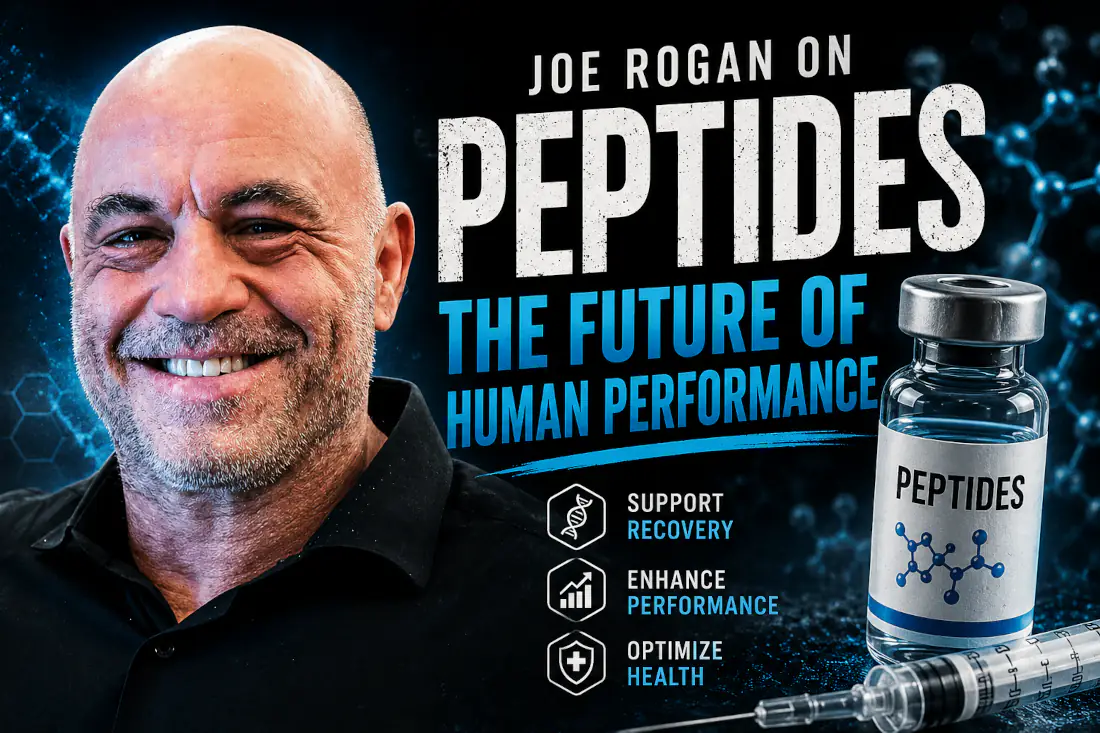
TLDR: Joe Rogan’s Peptide Protocol
- His peptide stack: BPC-157 and TB-500 for soft-tissue healing, ipamorelin with CJC-1295 for growth-hormone support, and thymosin for immune function. All sit on top of TRT and all used under medical supervision.
- BPC-157: The compound he talks about most. He credits it with clearing elbow tendonitis in two weeks and supporting his Achilles recovery, injecting directly into the injury site rather than subcutaneously.
- TB-500 and the Wolverine Stack: He pairs TB-500 with BPC-157 for what he calls the Wolverine Stack, a two-peptide blend for systemic soft-tissue recovery. TB-500 has even less human research than BPC-157.
- Ipamorelin and CJC-1295: Used together to stimulate the body’s own growth-hormone pulses rather than injecting GH directly. Human outcome data is limited.
- The FDA picture: BPC-157 has been on the FDA’s restricted compounding list since 2023. In February 2026, RFK Jr. told Rogan on the podcast that he wants to move around 14 peptides back toward legal access, with an advisory process underway.
- Buying it legally: As of May 2026, the only route that is not clearly on the wrong side of the line is a prescription through a licensed compounding pharmacy, for the peptides currently permitted.
- Testing first: Growth hormone peptides move IGF-1 and can affect fasting glucose, so without baseline bloodwork there is no way to tell whether a protocol is working or quietly causing problems.
What Peptides Joe Rogan Takes
Joe Rogan describes peptides as the layer on top of testosterone replacement, compounds that help the body produce more of the hormones it made when it was younger. However, this isn’t strictly true for many of the peptides, but it’s the way he characterized it. His stack has been consistent across multiple episodes.
Watch the full clip here.
The compounds he’s named are:
- BPC-157: His primary injury-healing peptide, and the one he talks about most.
- TB-500: Paired with BPC-157 for what he calls the Wolverine Stack.
- Thymosin (alpha-1 and/or beta-4): Mentioned for recovery and immune support. Thymosin beta-4 is the parent molecule TB-500 is derived from; thymosin alpha-1 targets immune function. Both remain on the FDA’s restricted compounding list as of May 2026.
- Ipamorelin and CJC-1295: A growth-hormone pairing he uses for recovery.
All of this sits on top of his long-running testosterone replacement therapy.
Peptides and TRT are not interchangeable. TRT replaces a hormone you have stopped making in enough quantity, while growth hormone peptides prompt your body to release more of what it still produces.
Readers whose real problem is the first one will get nowhere with the second, and are better served starting with a reputable TRT provider such as Hone Health, which tests before it prescribes.
For the wider picture of what else he uses, see our Joe Rogan supplements list article.
BPC-157
BPC-157 is a synthetic 15-amino-acid peptide and a fragment of a protein found naturally in gastric juice, which is why it’s also referred to as a gastric pentadecapeptide (source).
In rodent studies it’s been linked to tissue repair, the growth of new blood vessels (angiogenesis), and gut healing. That last property is part of why it gets discussed for soft-tissue injuries and gut conditions alike.
Rogan’s enthusiasm is tied to his own experience. He had elbow tendonitis he couldn’t shake, started using BPC-157, and says it was gone in two weeks (source). He’s also described using it during Achilles rehab. Andrew Huberman has credited two injections of BPC-157 with clearing up an L5 spinal compression that had left him in chronic pain. Rogan’s broader view is that athletes swear by it and there’s evidence it accelerates healing.
The human evidence is limited. Only around three small pilot studies exist; most published research is from rodents, and a large share of it traces back to a single research group in Croatia (source). In humans there’s essentially no data on half-life, mechanism, or long-term side effects (source).
How He Injects It
Joe Rogan injects BPC-157 directly into the injury site, and says local injection works better than going subcutaneous into the side or the love handles.
There’s a rationale behind the preference, at least on paper. Subcutaneous bioavailability may land somewhere around 30 to 80 percent depending on the site, and local injection could in theory help in superficial, low-blood-flow tissues like tendons. A preclinical half-life estimate of under 30 minutes is part of why local placement gets discussed. Both figures are preclinical estimates, not human data.
See the full episode here. Jump to ≈01:06:30 for this segment.
BPC-157 Dosing
Joe Rogan hasn’t confirmed a dose. The numbers that circulate come from compounding-clinic practice and preclinical work, and they’re general protocol guidance rather than a recommendation.
BPC-157: Commonly cited at 250 to 500 mcg once or twice daily, given subcutaneously or as a local injection. These figures haven’t been established in human trials, and long-term human safety data doesn’t exist.
What Gary Brecka Says About BPC-157
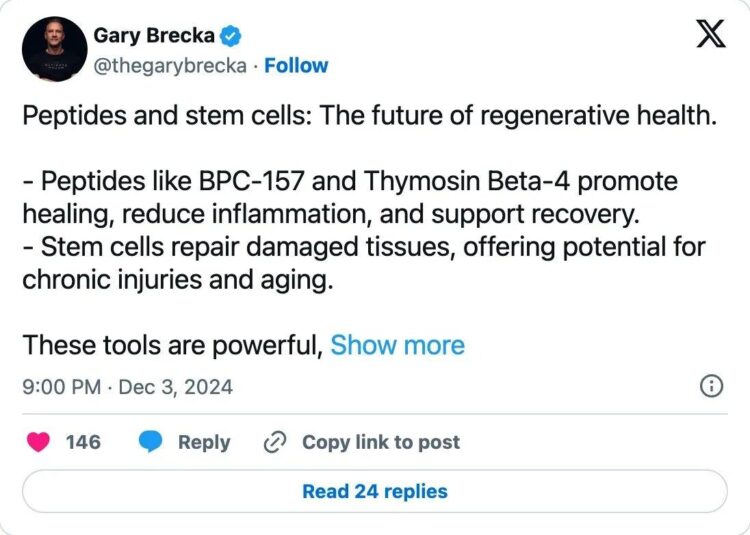
Gary Brecka, has explained the BPC-157 mechanism on the Joe Rogan podcast in some detail. He describes it as a gastric pentadecapeptide synthesised from gastric juice, says it’s tolerated well even orally, and says injecting it at the site of an injury helps call platelets to that location (source). He’s also pointed to gut applications, suggesting it can help with leaky gut and inflammatory bowel conditions.
Brecka’s strongest claim is about safety. He’s said his clinical team has put many thousands of patients on BPC-157 without a single adverse event.
Author’s Note: Brecka’s “thousands of patients, zero adverse events” figure is a clinical anecdote, not data.
Hear the full clip here.
TB-500 And The Wolverine Stack
TB-500 is a synthetic fragment of thymosin beta-4, used for systemic recovery rather than one specific injury site. Rogan pairs it with BPC-157 and calls the combination the Wolverine Stack, which is the two-peptide blend he leans on for soft-tissue healing, describing the effect as healing like a six-year-old.
The evidence base for TB-500 is thinner than BPC-157’s, with essentially no human randomised controlled trial data (source).
TB-500: Around 2.5 mg twice weekly during a loading phase, then roughly once weekly for maintenance. These figures come from veterinary-derived and clinic sources, not human trials.
BPC-157 and TB-500 are available together via telehealth, such as through Live Vital, which dispenses them as a physician-supervised protocol from a licensed US compounding pharmacy.
Ipamorelin And CJC-1295
Joe Rogan has named ipamorelin and CJC-1295 as part of his stack for growth-hormone support and recovery. The two are used together: ipamorelin prompts a growth-hormone pulse and CJC-1295 extends it, making the combination more potent than either compound alone.
A 2006 Phase I trial of CJC-1295 reported no serious adverse events across a small number of subjects, but it was a safety study, not an outcomes trial, and there are no large trials showing it does what enthusiasts hope.1Prolonged stimulation of growth hormone (GH) and insulin-like growth factor I secretion by CJC-1295, a long-acting analog of GH-releasing hormone, in healthy adults | Teichman et al. | 2006 | Journal of Clinical Endocrinology & Metabolism
Ipamorelin and CJC-1295: CJC-1295 with DAC is often cited around 2 to 3 mg weekly, per compounding-clinic practice.
CJC-1295 and Ipamorelin are available as a combined protocol via telehealth providers like Live Vital.
The FDA Story, And Why It’s Timely Again
The regulatory picture is the reason this topic keeps resurfacing.
- In September 2023, the FDA placed nearly 20 peptides on its Category 2 list, meaning compounding pharmacies were told not to formulate them. BPC-157 was among them (source).
- In late 2024, nominations for several peptides, including CJC-1295, ipamorelin, and thymosin alpha-1, were withdrawn from the Category 2 interim list; the FDA advisory committee then voted against permitting their compounding, leaving them restricted (source).
- In February 2026, RFK Jr. told Rogan on the podcast that he wants to move around 14 more peptides back toward legal compounding, and that an FDA action could come soon.
RFK said he’s a fan of peptides, that he’s used them himself on a couple of injuries, and that his hope is to get them somewhere people can access them through ethical suppliers. He also argued the original ban was improper because, in his telling, the FDA acted without a safety signal.
Catch the full clip here.
Joe Rogan himself has noted on the podcast that a lot of people are getting bogus peptides.
A safer route is a prescription through a licensed telehealth clinic. The gray-market compounds Rogan favors aren’t sold this way, but the closest legal growth-hormone peptide, Sermorelin, is. It’s available through US providers like Hone Health and AgelessRx, both of which work with licensed compounding pharmacies.
Is It Legal, And Can You Buy It?
As of May 2026, BPC-157 remains on the FDA’s Category 2 restricted list, pending advisory-committee review. It’s not FDA-approved, and selling it as a drug or supplement in the US isn’t legal (source).
That makes buying it legally murky. The only route that isn’t clearly on the wrong side of the line is a prescription dispensed through a licensed compounding pharmacy, for the peptides that are currently permitted. Anything bought online from a research-chemical vendor doesn’t come with quality assurance, which is the exact scenario Rogan flagged when he mentioned bogus products.
The picture differs by country. For how things stand across the Atlantic, see our explainer on whether peptides are legal in the UK.
Test Before You Inject
Joe Rogan has decades of bloodwork behind him and a doctor managing his testosterone. Most people copying a stack like this skip that part.
It matters because growth hormone peptides move IGF-1, and IGF-1 interacts with insulin sensitivity and fasting glucose. Without a starting number there is no way to tell whether a protocol is working or quietly causing problems. Credible telehealth clinics such as Hone Health will run the full panel and put a physician on the results, which is worth doing before you start and again a few months in.
Roundup
Joe Rogan’s peptide stack is consistent and easy to summarise: BPC-157 and TB-500 for soft-tissue recovery, ipamorelin with CJC-1295 for growth-hormone support, thymosin for immune support, all on top of TRT and all under a doctor. His stories about it are striking, and his framing is careful; he describes personal experience, not a protocol for everyone.
Human evidence is limited to a handful of small studies for BPC-157 and even less for the rest, long-term safety data doesn’t exist, and the compounds sit in a regulatory grey zone that may shift through 2026.
Further Reading
If this was useful, these articles go deeper on related ground:
- Andrew Huberman’s Peptide List: Andrew Huberman has covered ipamorelin, CJC-1295 and BPC-157 in detail on his podcast, with more context on dosing frameworks and the science behind growth-hormone peptide stacking.
- Gary Brecka’s Peptide Protocol: Gary Brecka is one of the most vocal public advocates for BPC-157, with a detailed breakdown of how he uses it and why he rates it above most other recovery compounds.
- Bryan Johnson’s Peptide List: Bryan Johnson has a more data-driven take on peptides, built around collagen, Epithalon and Thymulin with biomarker feedback at every step. A useful contrast to the recovery-focused approach covered here.
- Joe Rogan’s Diet: His return to a carnivore-based diet, what he eats day to day, and how it fits alongside his broader health and performance routine.
If you’ve got questions or comments, please leave them below.
FAQs
Rogan has named BPC-157, TB-500, thymosin, and ipamorelin with CJC-1295, all alongside testosterone replacement therapy and all under medical supervision (source). He hasn’t publicly stated his doses.
He says he prefers local injection, putting BPC-157 directly into the injury site, such as the Achilles, and finds it more effective than injecting subcutaneously into body fat. He’s used the subcutaneous route as well (source).
As of May 2026, BPC-157 isn’t FDA-approved and sits on the FDA’s restricted (Category 2) compounding list, so selling it as a drug or supplement is illegal (source). An FDA advisory process is underway that could change its status.
It’s a nickname for combining BPC-157 with TB-500, the two peptides he associates with soft-tissue recovery. He’s described the pairing as healing like a six-year-old (source).
On the podcast in February 2026, RFK Jr. said he’s a fan of peptides, has used them himself on injuries, and plans to move around 14 more peptides back toward legal compounding so people can access them through ethical suppliers (source).
Thumbnail: “Joe Rogan” by Daniel Torok (Official White House Photo, Public Domain)
References
- 1Prolonged stimulation of growth hormone (GH) and insulin-like growth factor I secretion by CJC-1295, a long-acting analog of GH-releasing hormone, in healthy adults | Teichman et al. | 2006 | Journal of Clinical Endocrinology & Metabolism ↩︎
Disclaimer: The above information is for research and educational purposes only and not a substitute for professional medical advice. See full medical disclaimer.
Note: We have no affiliation with Joe Rogan - this article is based on publicly shared information.
.jpg)